Oyindamola Ogunbowale
Arepo has quietly built a reputation as one of the more sought-after residential communities along the Lagos-Ogun axis.
Behind its gates are sprawling homes, gated estates and properties commanding prices that can make prospective buyers take a second look.
Its proximity to Lagos, growing population and reputation as a relatively affluent residential area have continued to attract homeowners, investors and property developers.
Indeed, Arepo is fast attracting development and buzz that many now regard it as ‘Second Magodo’.
But beyond the impressive houses and rising property values, another picture emerges.
For a community increasingly associated with affluence, Arepo’s everyday commercial environment appears surprisingly modest.
One of the clearest examples is banking.
While residents and businesses increasingly need convenient access to formal banking services, the presence of major commercial banks in the area does not appear to have expanded at the same pace as its residential development.
For some residents, banking errands can mean travelling outside their immediate neighbourhood rather than simply accessing a cluster of major banks nearby.
The contrast becomes more noticeable when Arepo is placed beside Ibafo, another rapidly developing community along the same Lagos-Ibadan corridor.
Ibafo has increasingly developed the feel of a busy commercial hub, with banks, eateries, marts, fast-food outlets and other businesses serving its growing population.
The difference is not necessarily that Ibafo has overtaken Arepo in every aspect of development.
Rather, the two communities appear to be growing in different directions.
In Ibafo you have banks like First Bank, UBA, Access and WEMA.
Mowe is also leading with top banks, with most of them nestling at the Redemption Camp.
These include some of the already mentioned brands as well as FCM and GTB.
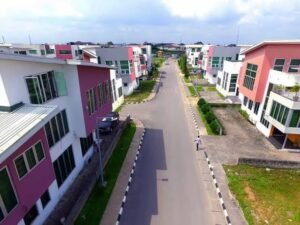
Arepo’s strength is particularly visible in its residential market.
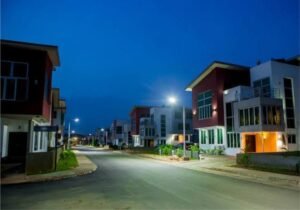
Property developments in the area increasingly market features associated with premium living, including gated communities, paved internal roads, drainage systems, security infrastructure, recreational facilities and dedicated power solutions.
Some developments in the area command tens of millions of naira for serviced plots, highlighting the premium attached to parts of the Arepo property market.
That creates an interesting contradiction.
If Arepo has become a premium residential destination, why does its wider commercial environment not appear to carry the same weight?
The issue extends beyond banks.
As the population grows, residents have reason to expect greater access to everyday amenities, from larger shopping outlets and organised commercial centres to stronger public infrastructure and essential services.
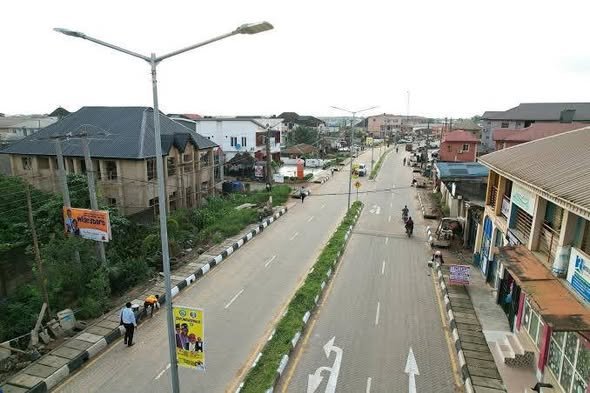
This is not to suggest that Arepo has been ignored completely. The community has received notable infrastructure investment, particularly in road development.
The 2.35km Journalists’ Estate Road was reconstructed with drainage, street lighting, walkways and other road infrastructure, and was commissioned in 2022.
The road serves several communities within the area. Yet the development conversation has moved beyond simply having good access roads.
A modern residential community needs more than beautiful houses. It needs the wider ecosystem that makes everyday life convenient.
That is where the comparison with Ibafo becomes particularly interesting.
Ibafo’s growing commercial activity gives it a different identity.
Residents can increasingly find banks, food outlets, shops and other businesses clustered around areas of daily activity.
Arepo, meanwhile, can give the impression of wealth through its estates and property prices without necessarily offering the same level of visible commercial density.
Then there is electricity, an area where some parts of Arepo appear to have an advantage over neighbouring communities.
So, the irony is difficult to miss. Arepo can command premium property prices, attract high-end residential developments and enjoy relatively better electricity in some areas, yet the community still appears to be playing catch up when it comes to the commercial conveniences that usually accompany such growth.
Perhaps that is the real question surrounding Arepo today. Is it genuinely becoming a fully developed highbrow community, or has it simply become a place where affluent people build expensive homes?
Because wealth in a community is not measured only by the price of its houses.
It is also reflected in the quality of its roads, the availability of essential services, the businesses willing to invest there, the ease of accessing everyday necessities and the infrastructure supporting the people who live there.
Arepo has clearly attracted the money. The bigger question now is whether its infrastructure and commercial opportunities will catch up with it.