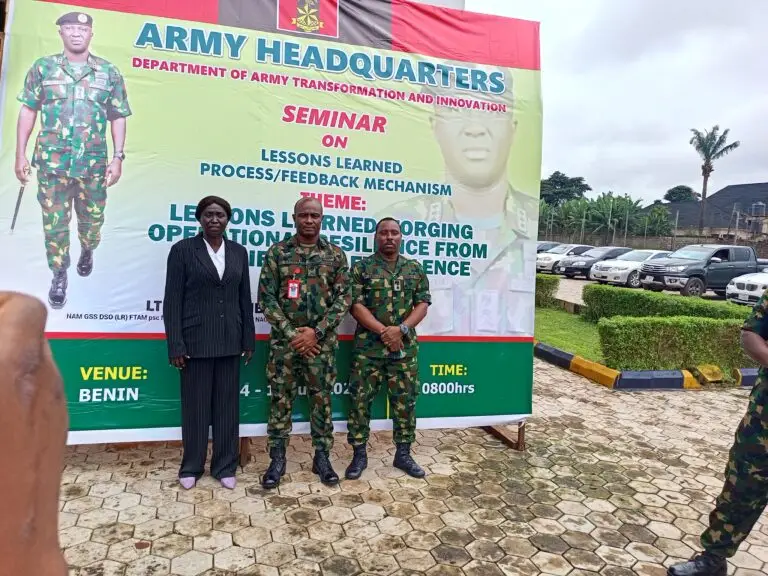
The Chief of Army Staff (COAS), Lt.-Gen. Waidi Shaibu, has warned its commanders of the consequences of engaging in drugs, warning that such act is unacceptable and would not be tolerated because it might compromise military operations.
The COAS also directed commanders at all levels to systematically integrate lessons from joint military operations into tactical planning.
Shaibu gave the directive on Wednesday in Benin at a sensitisation seminar organised by the Army Headquarters Department of Transformation and Innovation.
The directive, he said, was to reduce casualties, improve combat readiness and strengthen operational effectiveness.
The theme of the seminar was: “Lessons Learned/Feedback Mechanism: Integrating Lessons from Joint Operations into Nigerian Army Tactical Planning and Drug/Substance Abuse and PTSD Management for Troops of 4 Brigade, NASST and NASEME.”
The COAS, represented by the Commandant, Nigerian Army School of Supply and Transport (NASST), Maj.-Gen. Adebayo Adegbite, said lessons learnt remained central to operational success and should be drawn from both successes and failures.
“Lessons must continually be identified, properly analysed and applied in our day-to-day planning processes in order to reduce human casualties and operational costs,” he said.
Shaibu said the seminar formed part of the Nigerian Army’s efforts to equip junior and middle-level commanders with the capacity to respond effectively to Nigeria’s increasingly volatile and complex security environment.
He urged commanders to embrace innovation and critical thinking while continually reviewing tactics, techniques and procedures to improve battlefield performance.
“This seminar aims to reawaken critical thinking among commanders by fostering creativity and strengthening their ability to draw lessons from operational engagements,” he said.
According to him, the initiative aligns with his command philosophy of building “a more professional, adaptable, combat-ready and resilient force capable of decisively discharging its constitutional responsibilities within a joint and multi-agency environment.”
Earlier in his address, Maj.-Gen. Peter Okoye, Chief of Transformation and Innovation, Army headquarters, said the seminar was designed to improve troops’ understanding of the Army’s lessons learned process, drug and substance abuse prevention and post-traumatic stress disorder management.
Bassey, who was represented by the Deputy Chief of Transformation and Innovation, Maj.-Gen. Ime Bassey, said the programme would enhance troops’ ability to identify, document and analyse operational experiences to improve tactical planning, particularly in military operations within the South-South.
“The seminar is organised to enhance troops’ knowledge on how to extract, collate and analyse lessons in order to avoid the mistakes of the past while improving tactical planning outcomes,” he said.
He noted that lectures on operational feedback mechanisms, drug and substance abuse, and PTSD management were carefully selected to strengthen the professionalism, resilience and operational effectiveness of personnel.
Speaking with journalists after delivering a lecture, Dr Mitchell Ofoyeju, Edo Commander of the National Drug Law Enforcement Agency (NDLEA), warned that drug abuse posed a serious threat to military effectiveness and operational success.
“Drug is the enemy that is not in uniform but destroys from within,” Ofoyeju said.
According to him, illicit drugs impair judgment, slow reaction time or trigger irrational behaviour, making military personnel vulnerable during operations.
“If you are on depressants, you may be too slow to respond before the enemy gets you. If you are on stimulants, you might fire when it is not necessary.
“If you are not disciplined and don’t avoid drugs, you might even be tempted to fire at your own shadow,” he said.
Ofoyeju stressed that drug abuse had no respect for rank, age or status, warning that it could compromise operations, expose troops to enemy attacks and result in avoidable casualties and collateral damage.
He urged military personnel to maintain discipline and self-control to preserve their operational readiness and effectiveness.