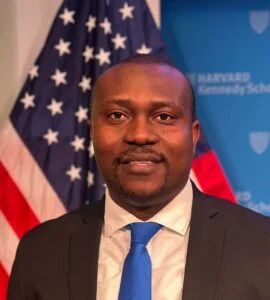
Dr Wasiu Olanrewaju-Smart, the Senior Special Assistant to the President on Inter-Governmental Affairs, says startups driven by STEM hold the key and possess the capacity to solve challenges facing the Africa.
Olanrewaju-Smart, a Harvard scholar and Policy Fellow at Quantum Alliance AI, Cambridge, Massachusetts, disclosed this at the AfriVatech iResearch Fellowship Cohort One Grand Pitch for the top seven young research fellows from Nigeria.
A former Egypt’s Minister of Health,Dr Halla Zaid, served as judge with the Presidential aide.
The News Agency of Nigeria (NAN) reports that the pitch , held through a webinar on Zoom, brought together innovative young Nigerians,who presented solutions to the continent’s problems through their research work.
The programme, moderated by Dr Moses Ojo and Mr Adewale Aboderin, featured a rigorous and transparent evaluation of seven finalists, who were assessed from their start up projects driven by technology models, particularly AI and Machine Learning models.
The organisers’ criteria for contestants, drawn from major Nigerian universities, included problem identification and relevance, innovation and originality, impact potential, leadership identification, communication and clarity.
One of the contestants, Mercy Sado, presented a research work centred on solutions to the health risks of adulterated honey.
She advocated the use of trusted harvesters, laboratory tests for approval, and the labelling of QR codes and batch numbers on each bottle to enable access to lab-test results.
Also, Tife Kerry, another fellow whose research work was titled “Green Cycle: Organic Fertilizer Production,” spoke on a technology-driven solution that turns agricultural waste into safe fertilizer (as against synthetic fertilizer),while improving public health and climate outcomes.
Kerry, who noted that farmers wanted better yields, healthier soil and reduced input costs, said Nigeria generates millions of tonnes of organic waste annually.
While Sekinah Adegbite of the University of Ibadan pitched on “Closing the Loop: A Digital Continuity Model for Hypertension and Diabetes Care in Nigeria,”
Aminat Adeshiyan presented a research work titled “BioSecured Futures.”
Boluwatife Balogun, who spoke on test strips through his research entitled “Sentisense Africa,” described the work as a decoupled surveillance system and a real-time defence against super bugs, highlighting the challenges of global antimicrobial resistance.
While Tolulope Oladipo presented his research on “Deciding Resistance: A Multimodal AI Framework for Health Surveillance,” Winner Bakati presented “RedBarn Agrihub,” a research-driven demonstration-led model for year-round vegetable production and household adoption.
Speaking after the presentations, Olanrewaju-Smart commended the contestants for their innovative ideas and their quest to find African solutions to African problems.
“At this critical time, no one is going to rescue Africa other than we Africans ourselves.
“I am glad that we have seen a lot of young people from our continent demonstrate the capability to address and provide home-grown solutions to our problems in Africa.
“I am proud of you, and I believe that for all of us on the side of regulation, the private sector and learning centres across Africa, it has dawned on us that we need to incentivise the field of STEM, and that is what has been demonstrated today.
“We have been able to prove that in Africa, we can use science and technology without dependence on foreign knowledge to address our problems.
According to him, Africa does not exist in isolation as “we are part of this global world.”
He said that Africa remains a significant partner in the world.
“From the project on using AI to address antimicrobial resistance challenges, to the Mama’s Honey project and the organic fertilizer project, what is assured is that we are capable of providing solutions to our problems.
“We will continue to intensify our research and particularly investment in the field of STEM,” he said.
Olanrewaju-Smart advised the contestants to go beyond Nigeria to identify solutions to problems confronting the entire African continent.
“We can do more and provide all-inclusive solutions to these problems pervading Africa,” he said.
After a brainstorming session between Dr Halla and Olanrewaju-Smart, Halla announced the top three performers, with Kerry taking first position with 84 per cent, Ado coming second with 67 per cent, while Balogun came third with 64.5 per cent.
Halla, who congratulated all the fellows on their efforts, innovative ideas and solutions, said she was very proud of the contestants for their good understanding of the problems and challenges in their communities.
She urged all participants to follow their dreams and achieve their targets.
The moderator, Aboderin, said that the top three contestants would join the AfriVatech research team to connect them with global opportunities, including funding of their science and tech startups.