By Usman Aliyu
As Nigeria prepares for the 2027 general elections, attention is turning to Permanent Voter Cards (PVCs), the Bimodal Voter Accreditation System (BVAS), electronic transmission of results through the IReV portal and election security.
However, another challenge that deserves equal attention is ensuring that electoral information retains its meaning as it moves from official announcements to the citizens expected to act on it.
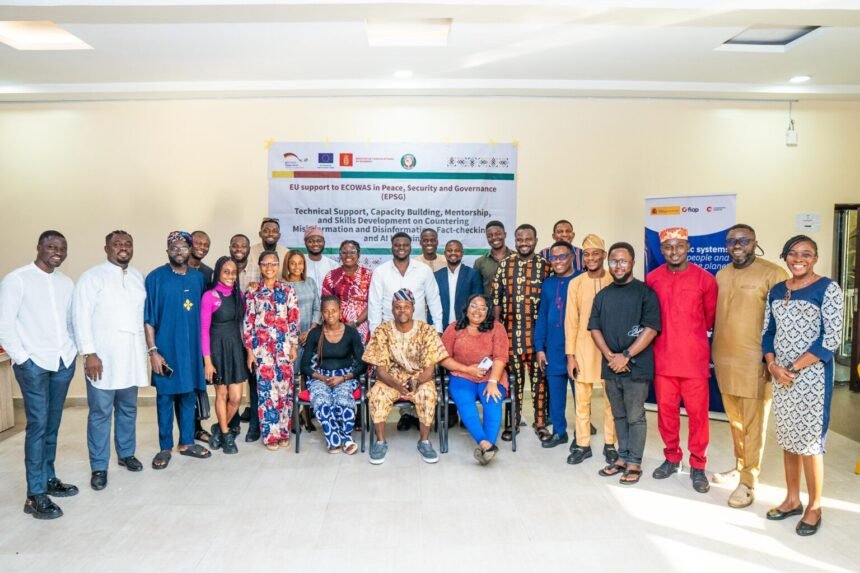
This was a central concern at a training on Indigenous Languages for Inclusive Electoral Coverage in Uyo, Akwa Ibom, organised by Fundación para la Internacionalización de las Administraciones Públicas (FIAP), a Spanish public-sector organisation.
The workshop was organised in collaboration with FactCheckAfrica under the European Union Support to ECOWAS in Peace, Security and Governance (EPSG) Project for selected journalists in Southern Nigeria.
The concern is significant in a country with an estimated 520 living indigenous languages, according to Ethnologue’s 2023 edition, as cited in a UK government country information report.
This linguistic diversity presents both an opportunity and a challenge for electoral communication, as citizens receive information through different languages and channels, including community radio, town-hall discussions, social networks and interpersonal communication.
Consequently, electoral information that is not accurately translated or properly contextualised can distort voting procedures, create confusion and fuel tension, especially when circulated without adequate verification.
The challenge is also linked to the growing influence of digital communication on electoral processes.
A Centre for Democracy and Development (CDD) report on Nigeria’s 2023 social media election campaigns put the number of active social media users at 36 million ahead of the elections, compared with 27 million in 2019.
Similarly, the European Union Election Observation Mission’s final report on Nigeria’s 2023 general elections identified inadequate capacity to verify malicious content in some local languages as a weakness in the country’s information integrity efforts.
These findings underline the importance of making electoral information accessible in languages citizens understand while ensuring that its original meaning and factual accuracy are preserved.
Against this backdrop, the workshop examined how journalists, translators and fact-checkers could protect the integrity of electoral information ahead of the next general election.
Mustapha Lawal, a programme lead with FactCheckAfrica, in his opening address, highlighted the translation gap and the need to equip media professionals to provide accurate and inclusive electoral coverage.
Complex electoral terminology, he noted, could lose important nuances when translated from English into indigenous languages.
The challenge becomes more evident when information passes through several channels before reaching its intended audience.
An official statement may be summarised, translated, paraphrased, recorded as a voice note and forwarded through messaging groups before reaching a community.

At each stage, a qualification can disappear, a possibility can become a certainty, or a limited instruction can be presented as a general directive.
For instance, a hypothetical announcement that voting may be extended at specified polling units, subject to approval, could be retold as a blanket instruction for voters to return another day.
When delivered in a familiar voice, the inaccurate version may be accepted as credible, even without supporting evidence.
This creates a misinformation chain in which a minor distortion can acquire wider significance through repetition and circulation.
The problem is not simply finding equivalent words in another language.
Prof. Nsikak Idiong, a scholar of journalism, political communication and media studies at the University of Uyo, who facilitated sessions at the workshop, addressed the structural and contextual difficulties of translating electoral language.
Terms such as counting, collation and declaration illustrate the problem.
Counting involves determining the votes cast for candidates at a polling unit, while collation involves aggregating results from different polling units and electoral levels.
Declaration, on the other hand, is the formal announcement of an election outcome by the appropriate returning officer.
If a translator uses one expression for all three processes, an update on counting at a polling unit could be misunderstood as a final declaration of results.
Such confusion could create room for premature victory claims, anxiety and disputes.
Idiong’s presentation underlined the importance of conveying the precise electoral process rather than relying on literal, word-for-word translation that may obscure distinctions essential to public understanding.
Against this backdrop, contextual translation becomes necessary.
It involves communicating the intended meaning in language that audiences understand while preserving the original statement’s scope, conditions and factual accuracy.
Where a direct equivalent does not exist, journalists may need to provide a concise explanation rather than force a translation that could alter the meaning.
More importantly, journalists must distinguish between making information accessible and reproducing claims without adequate verification.
Theresa Donatus of the Daily Times stressed the value of accurate reporting in helping citizens make informed choices about their civic responsibilities.
Ezinne Alozie, a broadcast journalist with Darling FM, highlighted language’s role as a currency of communication and identity, reinforcing the need to fact-check information before it is broadcast or shared.
Dr Christopher Okon, a communication lecturer, examined how audiences interpret messages differently based on their experiences, beliefs and levels of trust.
People understand information through their experiences, beliefs and levels of trust.
While some accept messages as presented, others negotiate their meanings, while some reject them.
For journalists, this means that publishing an accurate statement is not the end of their responsibility. They must also consider how different audiences may interpret and circulate the information.
This responsibility becomes even more important when reporting on vulnerable groups, including women in politics, persons with disabilities, internally displaced persons and rural voters.
Coverage that relies on stereotypes, sensationalism or inflammatory identity-based framing can deepen exclusion and undermine public understanding.
Meanwhile, the workshop highlighted the need to uphold professional and legal standards, including relevant provisions of the Electoral Act 2022, the Nigeria Broadcasting Code and the Nigerian Union of Journalists’ Code of Ethics.
Inclusive reporting should give communities access to useful information without exposing marginalised people to stigma or portraying them through prejudicial assumptions.
To address the challenge of reporting inflammatory rhetoric without amplifying it, participants examined the Sandwich Method.
Under the approach, a journalist begins with verified facts and context, includes an inflammatory statement only when necessary and with clear attribution, and then returns to the factual position to explain the relevant consequences.
The method helps ensure that provocative claims do not dominate reports at the expense of evidence.
Abideen Olasupo, founder of FactCheckAfrica, emphasised the importance of collaboration in making electoral information accessible in languages citizens trust and use daily.

One practical outcome of the workshop was work on indigenous-language electoral glossaries.
Participants validated Yoruba and Igbo glossary drafts and began developing an Ibibio version, drawing on contributions from media professionals from Akwa Ibom, Lagos, Enugu, Edo, Oyo, Rivers, Anambra and Cross River states, among others.
The glossaries are expected to promote consistency in the use of electoral terminology and help journalists avoid conflicting interpretations of important processes.
However, developing glossaries alone will not eliminate misinformation.
Newsrooms also need clear translation and verification procedures, rapid correction of misleading reports and communication formats that reflect how different audiences receive information, including audio-based channels and community networks.
In addition, collaboration between journalists, language experts, fact-checkers, electoral authorities and community leaders will be essential in ensuring that translated information remains accurate and accessible.
As the 2027 elections approach, the workshop’s message is clear; electoral integrity depends not only on the accuracy of information released by authorities but also on whether its meaning remains intact as it reaches the people expected to act on it.
Getting the language right is therefore more than a technical exercise.
It is part of ensuring that voters understand electoral procedures, assess claims critically and make informed decisions without being misled by distortions in translation.
- Aliyu writes for te News Agency of Nigeria