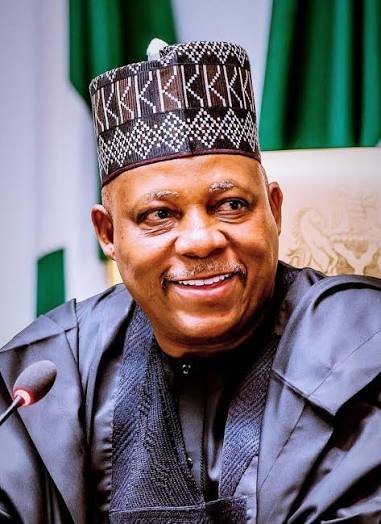
Vice-President Kashim Shettima has proposed annual reviews of states’ electricity markets to assess implementation of the Electricity Act, 2023, and accelerate reforms in the power sector.
Shettima, represented by the Deputy Chief of Staff to the President, Sen. Ibrahim Hadejia, made the proposal at a national stakeholders’ workshop on the Act in Abuja on Wednesday.
He called for a National Electricity Reform Review and Implementation Framework involving the Nigerian Electricity Regulatory Commission (NERC), the Federal Ministry of Power, the Nigeria Governors’ Forum and state electricity regulatory institutions.
He said the annual reviews would help identify bottlenecks, track progress and attract investment, urging states yet to establish electricity regulatory commissions to begin the necessary legislative and institutional processes.
“The success of the reform should be measured not by the number of commissions established but by the electricity generated, investments attracted, jobs created, reliability of supply and improvements in the lives of our citizens,” he said.
Shettima urged states to adopt transparent licensing procedures, predictable regulations and commercially viable arrangements to attract private investment. He also stressed the need to protect consumers through fair billing, reliable services and effective complaint-resolution mechanisms.
“The average Nigerian is not interested in the complexities of electricity regulation. He wants electricity that works,” he said.
The Minister of Power, Joseph Tegbe, said the success of the reform depended on states establishing credible regulatory institutions, attracting private capital and improving electricity services.
He identified institutional capacity, viable electricity markets, coordination with the national grid and consumer protection as key priorities. He added that state regulators needed competent personnel, adequate funding, transparent tariff processes and sufficient independence.
Tegbe also urged states to establish predictable regulations, enforceable contracts and clear arrangements for managing the transition from federal to state regulation. He warned that existing contracts and financial obligations would remain in force despite the transfer of regulatory responsibilities.
The Chairman of the Nigeria Governors’ Forum, Gov. Abdulrahman AbdulRazaq of Kwara, said amendments to the Electricity Act must protect states’ regulatory powers without creating uncertainty that could discourage investment.
Represented by the forum’s Director-General, Abdulateef Shittu, AbdulRazaq said the NGF had supported states through technical workshops and legislative and regulatory templates, working with partners including the British High Commission and UK International Development.
The Chairman of NERC, Musiliu Oseni, said the commission had issued transfer orders to 17 states to enable them to assume regulatory oversight of their electricity markets.
He added that NERC had supported emerging state regulators through training, capacity-building programmes and technical engagements.
Oseni said the Electricity Act, 2023, following a constitutional amendment, allowed states to legislate on and regulate electricity generation, transmission and distribution within their territories.
He said decentralised regulation could bring oversight closer to consumers and help address local needs, but cautioned that the transition required careful management to maintain regulatory stability and investor confidence.