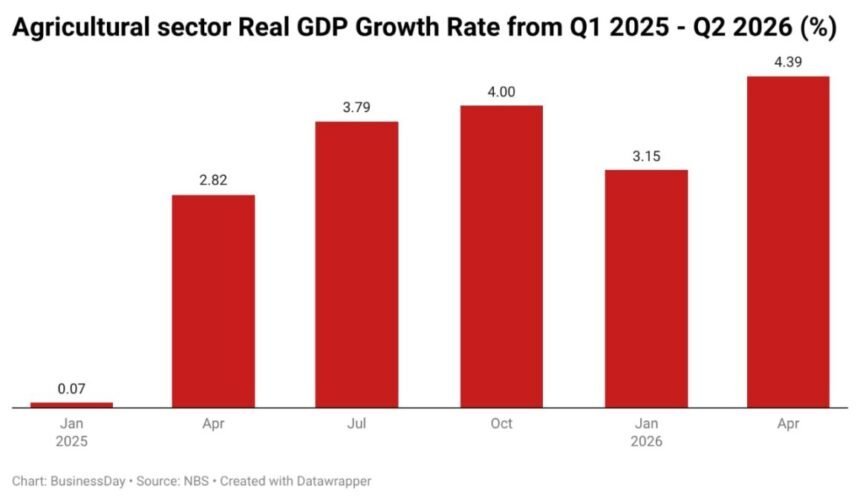
The Federal Government says Nigeria’s agricultural sector grew by 4.39 per cent in the second quarter of 2026, marking its strongest growth trajectory since 2021.
The Minister of State for Agriculture and Food Security, Aliyu Abdullahi, disclosed this during the commemoration of World Food Day 2026, themed “Innovate Today. Nourish Tomorrow”.
Abdullahi said crop production grew by 3.66 per cent during the period, according to the National Bureau of Statistics, attributing the progress to government reforms and investments.
He said the National Agricultural Growth Scheme and Agro-Pocket had supported smallholder farmers to produce 2.5 million metric tonnes of staple foods across four farming seasons, while annual domestic wheat production had risen to about 420,000 metric tonnes from 120,000 metric tonnes.
Other interventions include the deployment of 2,000 tractors under the Renewed Hope Agricultural Mechanisation Programme, expanded dry-season farming, soil mapping, improved irrigation and digital agricultural advisory services.
Abdullahi said investments in storage, cold-chain facilities and Special Agro-Industrial Processing Zones were aimed at reducing post-harvest losses from 40 per cent to below 20 per cent. He added that the government was strengthening agricultural financing, insurance and security around farmlands.
“Food security is a collective responsibility. We remain resolute in building a sector capable of feeding the nation and driving economic growth,” he said.
The ministry’s Permanent Secretary, Marcus Ogunbiyi, said World Food Day, observed annually on Oct. 16, highlighted the importance of innovation in improving food production, storage, processing and distribution.
He called for increased agricultural productivity, private-sector investment and stronger resilience to climate, economic and security challenges to ensure access to safe and nutritious food.
Ogunbiyi reaffirmed the government’s commitment to agriculture as a driver of economic growth, job creation and food security, while commending international development partners, women and young farmers for their contributions.