Suara Sherif
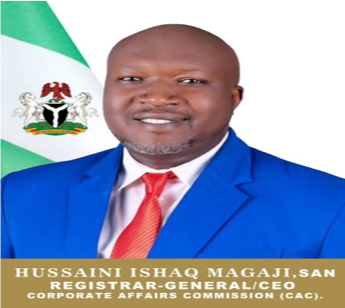
The Registrar General of the Corporate Affairs Commission, Hussaini Magaji, has raised alarm over Nigeria’s fragmented beneficial ownership registers, warning that scattered corporate data is weakening the fight against illicit financial flows and calling for a harmonised national system.
Magaji said Nigeria’s corporate ownership information remains dispersed across multiple institutional databases, with the CAC maintaining the Beneficial Ownership Register, the Nigeria Export Processing Zones Authority overseeing entities in Free Trade Zones, and the Nigeria Extractive Industries Transparency Initiative holding records for the extractive sector.
Speaking at a training for journalists and civil society organisations in Abuja on Tuesday, he said the country urgently needs an interconnected framework that makes it easier to identify the individuals who ultimately own or control companies.
“Nigeria should work towards harmonising and centralising beneficial ownership information within a coordinated national framework, with the CAC corporate registry serving as the central corporate data backbone,” he said.
Magaji stressed that the push for centralisation is not an attempt to take over the roles of other agencies.
“This is not about taking away the legitimate statutory responsibilities of NEPZA or NEITI. It is about connecting the dots. It is about ensuring that the Nigerian beneficial ownership ecosystem speaks with one voice, one standard and one level of transparency,” Magaji stated.
He cautioned that transparency is defeated when information is held in silos.
“If the objective is transparency and accountability, then information should not exist in silos.”
A company may operate in different sectors. Its ownership structure should not become invisible simply because the information sits in different institutional compartments,” he said.
The call comes as Nigeria intensifies efforts to improve corporate transparency and curb the use of companies as vehicles for corruption, tax evasion and other illicit financial activities.
He noted that anti-graft and law enforcement agencies, including the ICPC, EFCC and NDLEA, have utilised beneficial ownership data in investigations.
Magaji also charged journalists and CSOs to advocate for interoperability and common standards across registers, while respecting legitimate privacy and data protection requirements.
He warned against treating the appearance of a name in a corporate record as evidence of wrongdoing, stressing that such information must be independently verified and reported fairly.
He disclosed that access to the CAC’s beneficial ownership data is free, saying “transparency should not become a privilege available only to those who can afford it.”
The Commission also announced plans to host a Global Conference on Beneficial Ownership in Lagos on November 8, 2026, expected to draw about 200 delegates from 43 countries.
While the proposed harmonisation does not by itself guarantee an end to illicit financial flows, Magaji said a unified and interoperable system is critical to strengthening corporate accountability and protecting public resources.