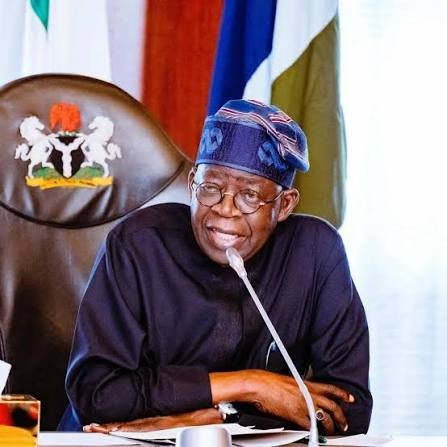
President Bola Tinubu has directed that liquid funds recovered by the Economic and Financial Crimes Commission (EFCC) be channeled to the Nigerian Education Loan Fund (NELFund).
The Minister of Education, Dr Tunji Alausa, disclosed this on Wednesday while briefing State House correspondents after the Federal Executive Council (FEC) meeting presided over by Tinubu in Abuja.
Alausa said the President also directed that unclaimed dividends from the Capital Market Trust Fund and Dormant Account Trust Fund be channeled to NELFund.
He, however, clarified that the directive applied only to liquid, unencumbered funds that were not subject to legal disputes or other restrictions.
“The President, in his benevolence, has now directed that all funds recovered by the Economic and Financial Crimes Commission be diverted to NELFund to continue to support its funding,” Alausa said.
He said the President had also directed the Ministers of Finance and Justice, the Debt Management Office and other relevant agencies to work with the Education Ministry on the legal and operational framework.
According to him, the Justice Minister, Lateef Fagbemi will review the laws establishing the two trust funds to determine how the unclaimed dividends can legally be transferred to NELFund.
He said the Attorney-General would also work with the EFCC Chairman to identify eligible liquid funds recovered by the commission for transfer to NELFund.
“Note, and the President was very clear, not seized properties, or recovered looted funds, but liquid funds, from the EFCC will now be transferred to NELFund,” the minister said.
Alausa said the decision would strengthen NELFund’s financial capacity as demand for student loans continued to grow, adding that more than 1.2 million Nigerian students had benefited from the scheme.
He said NELFund had also disbursed more than N93 billion in stipends to students in federal and state public institutions and over N250 billion in institutional fees.
The minister said the development demonstrated Tinubu’s commitment to fulfilling his campaign promise of expanding access to quality higher education through sustainable student-loan financing.
“The education of our children cannot wait, is of utmost importance to him, and he will do anything and everything to protect the future of every single Nigerian child, every single Nigerian student,” he said.
Alausa also disclosed that FEC approved the transformation of the Suleja Academy into the Nigeria Academy for the Gifted and Talented, to provide specialised support for exceptionally gifted Nigerian children.
He said the academy would operate autonomously, with its own governing structure and diversified funding sources, including government appropriation, endowment and donations.
“We need to do this because we have to look for every single genius in this country and bring them in, nurture them, and let them help create the Nigeria of tomorrow,” he said.
The minister said FEC also approved the augmentation of the existing contract for completion of the National Library of Nigeria, which had been abandoned for about 18 years.
He said construction of the library began in April 2006, with a projected two-year completion period, but work stopped in October 2008.
Alausa noted that funds had been sourced from the Tertiary Education Trust Fund (TETFund), while additional support had been mobilised from the First Lady, Oluremi Tinubu, to enable work to resume on the project.
He also disclosed that FEC approved the deployment of an entrepreneurship, innovation and business incubation certification programme in 14 federal universities.
According to him, the technology-driven programme will equip students with entrepreneurship, innovation, enterprise development and digital skills, alongside mentorship and incubation support.
He said the programme, which had been tested at the University of Lagos, was designed to transform students from job seekers into job creators and innovators.
The 14 universities include Ahmadu Bello University, Bayero University Kano, Nnamdi Azikiwe University, Obafemi Awolowo University, University of Abuja, and University of Benin.
Others are University of Ibadan, University of Ilorin, University of Jos, University of Lagos, University of Maiduguri, University of Nigeria Nsukka, University of Port Harcourt and Usmanu Danfodiyo University, Sokoto.