The Economic Community of West African States (ECOWAS) has called on member states to fully implement existing protocols and policies aimed at promoting the growth of Micro, Small and Medium Enterprises (MSMEs) across the sub-region.
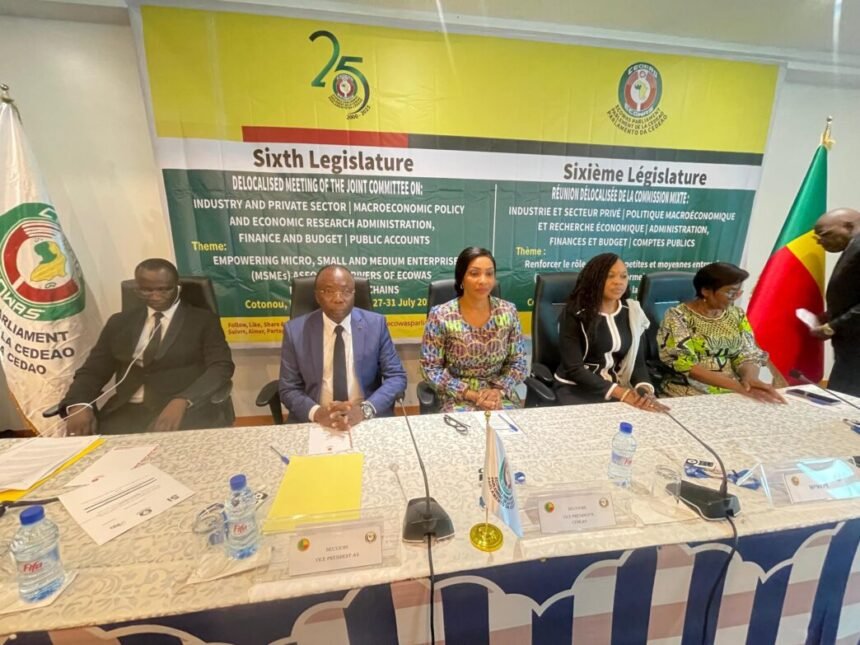
The appeal was made by Tony Elumelu of the ECOWAS Business Council Secretariat during the ongoing delocalised meeting of the ECOWAS Parliament’s Joint Committee in Cotonou, Benin Republic.
The Joint Committee comprises the Committees on Industry and Private Sector; Macroeconomic Policy; Economic Research; Administration, Finance, Budget and Public Accounts.
Delivering a presentation titled, “Trade Facilitation, Regulatory Reforms and Formalisation,” Elumelu urged member states to remove obstacles hindering the growth of MSMEs and impose sanctions on those undermining existing regulations.
He noted that ECOWAS had already adopted robust policies, protocols and legal instruments to support private sector development, stressing that the priority should now be implementation rather than introducing new policies.
“The formulation of new policies is not what MSMEs within the sub-region need presently, but it’s rather the creation of an enabling environment for businesses to thrive.
“What we need to do is to enforce those policies that we have already adopted, and remove every bottleneck that impedes MSMEs from thriving.
“My recommendation is that we should implement what we have adopted and make sure that we create an enabling environment for these businesses to thrive, and not keep adopting policies,” he said.
Elumelu also urged ECOWAS member states to avoid unnecessary disruptions to legitimate cross-border trade in order to maximise the opportunities provided by the African Continental Free Trade Agreement (AfCFTA).
He identified the numerous checkpoints along highways within the sub-region as a major obstacle to the growth of MSMEs and regional economic integration.
“We need to make sure that we have the necessary infrastructure that our goods will use in terms of moving from one country to another, we also need to look at the vision that we have signed for the AfCFTA protocol,” he added.
Also speaking, ECOWAS Principal Programme Officer for Enterprise and Business Promotion, Dr Olalekan Afolabi, called for the formalisation of the informal sector, which accounts for a significant proportion of MSMEs.
He urged the ECOWAS Parliament to encourage regional leaders to implement existing policies that would strengthen MSMEs and promote economic development across the sub-region.
Afolabi said many businesses operating informally should be integrated into the formal economy to enhance growth and regulatory compliance.
He also advocated the implementation of the European Union-funded African Trade Competitiveness and Market Access Programme, valued at €50 million.
“How do we implement the African Trade Competitive and Market Access Programme of the European Union, and some of the responses we give to them include going to the national level and seeing that these policies are properly domesticated?
“These policies are legislated at the national level and also coming to hold us accountable at the regional level, because we need to report periodically to the parliamentarians.
“They need to monitor the implementation of some of those projects and this forum, of course, presents an opportunity for things like this,” he said.