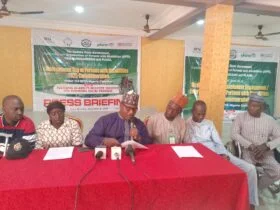
The National President of the Persons With Physical Disabilities, Mr. Rilwani Mohammed, has reiterated that equality, dignity and inclusion were fundamental rights of persons with disabilities and not privileges.
Mohammed, who doubles as the Chairman of the Organisation of Persons With Disabilities (OPDs) in Kaduna, spoke at a media parley and stakeholders engagement to commemorate the 2025 International Day of Persons With Disabilities (PWDs)
The theme for this year’s commemoration was, “Fostering Disability Inclusive Societies for Advancing Social Progress”.
The News Agency of Nigeria reports that the event, held under the BETA Nigeria campaign, was organised by the Kaduna State Government and OPDs with support from the Partnership for Learning for All in Nigeria (PLANE) programme.
Mohammed said the theme reflects the aspiration to build a Kaduna State where dignity, participation and equal opportunities are guaranteed for all individuals with disabilities.
He said inclusive education is fundamental to social progress and stressed that every child with a disability deserves to learn in an environment that nurtures potential and promotes dignity and equal participation.
He emphasised that enrolling children with disabilities in public schools is a moral, legal and developmental imperative that strengthens learning outcomes, promotes social cohesion and eliminates discrimination.
He lamented that children with disabilities still face systemic exclusion from education, healthcare, employment, infrastructure and social protection across society.
He said social progress and poverty eradication are impossible without placing disability inclusion at the centre of national development and public participation.
Mohammed said Nigeria must integrate disability inclusion into national planning and budgeting to achieve Sustainable Development Goals 4, 8, 10, 11 and 17.
He said OPDs are seeking more support from government, private sector, development partners and communities to strengthen inclusive education, accessible infrastructure, inclusive policies and economic empowerment.
He said political participation of persons with disabilities must be strengthened to ensure representation in leadership and decision making.
He said inclusion in sustainable development requires engagement of persons with disabilities in agriculture, climate action, environmental management and food security initiatives.
He explained that PLANE supported teacher capacity development, school support and inclusive education advocacy that continue to shape policy implementation in the state.
Mohammed said PLANE enhanced community awareness and promoted inclusive school environments through partnerships with OPDs and education actors.
He said PLANE trained Inclusive Education Desk Officers across 19 local government areas to strengthen identification, support and monitoring of learners with disabilities.
He said the programme strengthened safeguarding practices, improved learning assessments, enhanced school data systems and supported policy implementation.
Mohammed urged stakeholders to renew their commitment to enrolling, supporting and retaining children with disabilities in public schools.
He also urged the Kaduna State Government to sustain and accelerate inclusive education frameworks across public schools.
He thanked development partners for technical expertise, advocacy and investments that improved learning systems and disability rights awareness.
He commended the media for consistent coverage and storytelling that amplified disability voices across Kaduna State.
He appreciated civil society organisations, parents’ groups and the broader OPDs movement for strengthening grassroots mobilisation and collaboration.
The Team Lead of PLANE in Kaduna, Mrs Diana Agabi, described the event as a call to action and reaffirmed commitment to disability enrolment, early identification and policy shaping initiatives.
Agabi, represented by Musa Jimoh, Results and Learning Manager of PLANE, said disability enrolment drives across six local government areas resulted in more than 3,000 children with disabilities being enrolled in public schools.
She said PLANE piloted the Washington Group Child Functioning Model to strengthen early education and learning interventions for Primary One learners.
She added that PLANE provided ongoing teacher development, school support and advocacy for inclusive education.
Agabi equally said that PLANE enhanced community awareness, strengthened partnerships with OPDs and trained inclusive education officers across 19 local government areas.
She said the programme strengthened safeguarding practices, improved learning assessments, enhanced data systems and supported robust policy implementation.
Mr Mukhtar Maude, the Director Public Schools, Kaduna State Ministry of Education said the observance reminds society that inclusion is a fundamental right and prerequisite for sustainable development.
He said the ministry remains committed to strengthening inclusive education, expanding learning opportunities and promoting policies that uphold dignity and participation.
Mr Tijjani Aliyu, the Co-chair, Kaduna Basic Education Accountability Mechanism (KADBEAM), represented by Mr Simeon Olatunde, said the organisation has for over six years advocated for inclusion across basic, secondary and tertiary education.
Mr. Silas Dogo, Planning Officer of the Kaduna State Disability Affairs Board, thanked PLANE for supporting programmes.
He said the theme of the commemoration provided an opportunity to expand inclusion in policies, practices and partnerships.
Mr Busayo Akintunde, the Chaiman, National Association of Proprietors of Private Schools, Kaduna chapter, said private schools were fully part of state driven activities promoting inclusive education.
He thanked the Ministry of Education and SUBEB for trainings, workshops and seminars that improved service delivery to learners with disabilities.
In a keynote address, Esther Jibji, the Director Special Programme of SUBEB, said inclusive education improves academic outcomes, social skills, workforce preparation and barrier removal while promoting acceptance and dignity.
She said inclusive education aligns with international human rights standards and supports sustainable development by reducing stigma.
According to her, Governor Uba Sani demonstrated commitment by strengthening partnerships, providing inclusive infrastructure and training teachers and desk officers.
Jibji said the PLANE supported programme trained inclusive education desk officers across 19 local government areas and stepped down training to community stakeholders.
She said government led enrolment campaigns and community engagement returned 3,177 out of school learners with disabilities across 20 local government areas.
She said 1,930 enrolled learners were male and 1,247 female.
She equally said 690 primary Olone learners were assessed using the Child Functioning Module.
She said 619 learners had no functional difficulties while 71 learners had at least one functional difficulty.
Jibji said Sanga local government area recorded the highest prevalence at 29.2 per cent while Soba recorded the lowest at 4.6 per cent.
She listed challenges including insufficient funding, lack of comprehensive data, weak early identification, limited assistive technologies, low awareness, inadequate training and weak stakeholder collaboration.
She recommended stronger collaboration, increased media engagement, multi year funding, community mobilisation and scaling of early identification tools.
She said inclusive education is a fundamental right and foundation for social progress and economic advancement.
Jibji called for deliberate action to make every school accessible, train every teacher and empower every parent.
NAN reports that a panel session was held on fostering disability inclusive societies: policies, practices and partnerships for advancing social progress in Kaduna state.
A panel session was also held on shaping public narratives: the role of media on fostering disability-inclusive societies and advancing social progress.