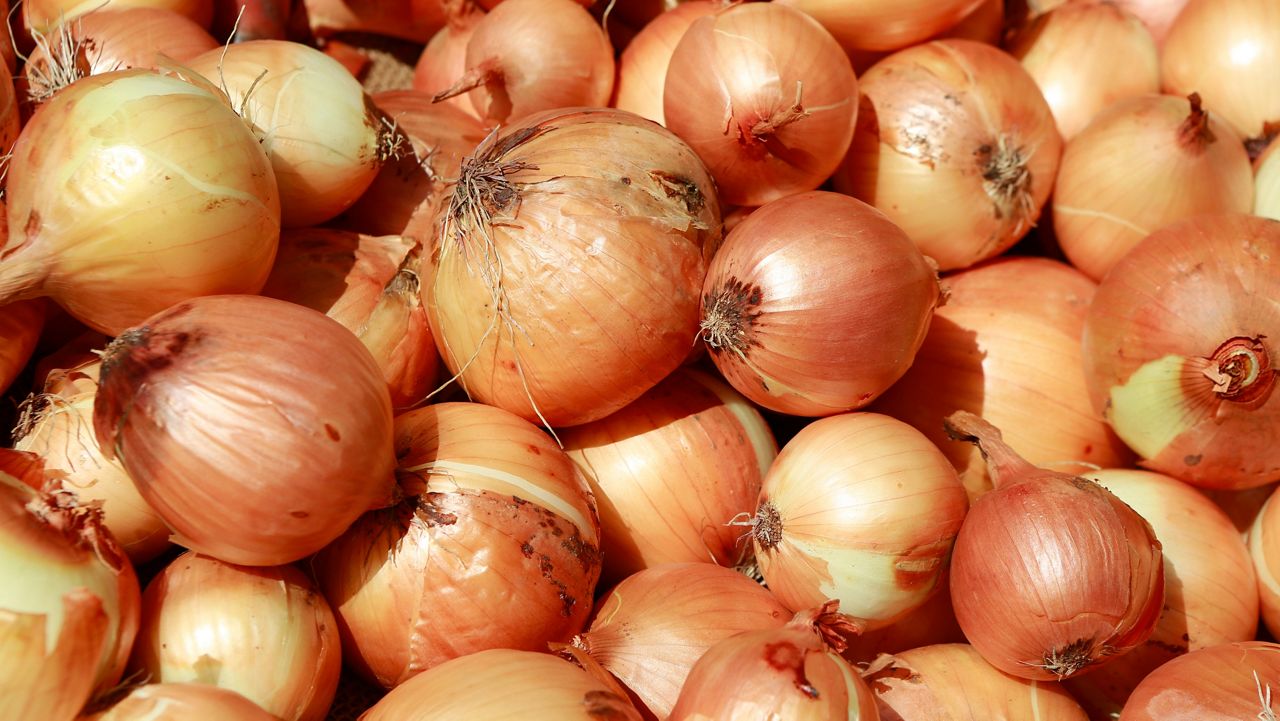
Many residents of the Federal Capital Territory (FCT) have expressed concern over soaring onion prices.
According to them, the increase is raising household expenses and business operating costs.
Checks by the News Agency of Nigeria (NAN) at some markets across the FCT on Sunday showed significant increases in onion prices.
A bag previously sold for between N120,000 and N130,000 now costs between N250,000 and N280,000, depending on its size.
Smaller bags sell for about N180,000, while a big basket previously sold for N70,000 to N75,000 now costs N125,000 to N140,000.
A small basket, which previously sold for N8,000 to N9,500, now costs between N11,000 and N13,000.
Sulaiman Ma’azu, an onion trader in Suleja, attributed the increase to seasonal scarcity.
He said the rainy-season harvest had passed, while the dry-season crop was yet to become available.
“Onions are not really in season now. The rainy-season crop has passed, while the dry-season crop has not yet come.
“That is why the onions available in the market are quite scarce,” he said.
Ma’azu said prices varied according to the quality of the onions, with some selling between N180,000 and N280,000.
He said the high cost of purchasing new stock also made it difficult for traders to reduce their selling prices.
“When customers complain that prices keep increasing, we explain that it is not entirely from us.
“If we buy our stock at a high price, we have to sell it at a price that allows us to restock. If we get it cheaply, we also sell it cheaply,” he said.
Another trader in Kubwa, Sabiu Muhammad, attributed the increase to poor returns recorded by farmers during the previous farming season.
He said some farmers had abandoned production, while post-harvest losses and transportation costs further affected market supply.
“Some farmers did not make enough money from their onion farms last season, forcing them to abandon production.
“Post-harvest losses and high transportation costs have also affected the supply of onions in the market,” he said.
A resident of Dei-Dei, Sadiya Aminu, said the increase had forced her to spend more while reducing the quantity of onions she bought.
She said she usually bought onions in bulk, with a small basket lasting her household between 10 and 14 days.
“I usually buy onions in bulk, but because of the constant increase in prices, I now buy smaller quantities to manage my household expenses.
“Two weeks ago, I bought the same quantity of onions for N1,500, but this week, I had to pay N2,500 for it,” she said.
Another resident, Ruth Okafor said the higher cost was forcing her to reduce the quantity she bought for household use.
“Before now, the amount I spent on onions could buy enough to last for several days. But now, I spend more money and get less quantity. It is becoming difficult to manage,” she said.
She said onions remained an important ingredient in preparing meals, making it difficult to stop buying them in spite of the higher prices.
Glory Akpan of Cali Kitchen, Gwarimpa, said her weekly spending on onions had increased from between N8,000 and N10,000 to between N15,000 and N18,000.
She said the increase was affecting her profit because ingredient costs were rising, while increasing food prices remained difficult.
“This is really affecting our profit. What we used to make before is no longer what we make now.
“The cost of purchasing ingredients keeps increasing, but increasing food prices is not something we can just do because customers may not be able to afford it,” she said.
Similarly, Mary Odiori, a food vendor in Kagini, said higher ingredient and transportation costs were reducing her earnings.
“The increase is affecting us seriously. Sometimes, after buying ingredients, paying for transportation and other expenses, what remains is very little.
“We are just trying to keep the business running,” she said.
Odiori said she had increased the prices of some meals to cope with the higher operating costs.
“I have increased some of my food prices because I cannot continue selling at the old prices and expect to survive, but I still try to ensure that customers get something reasonable for their money,” she said.
The traders called for increased support for onion farmers, particularly in production, storage and transportation to improve supply and moderate prices