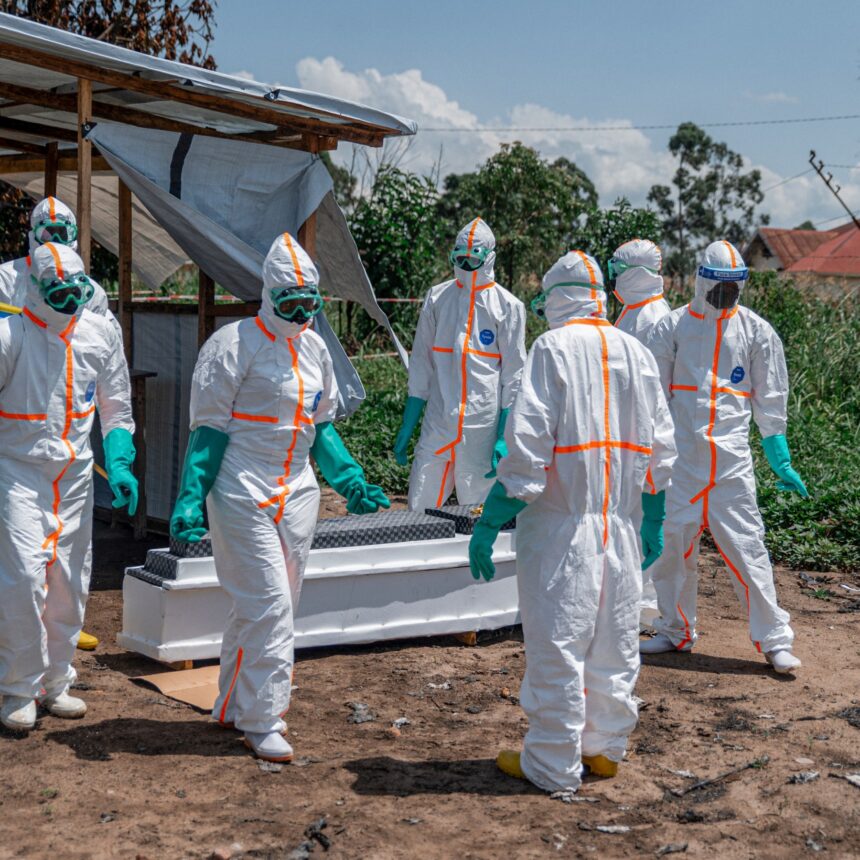
With Nigeria’s imported Bundibugyo Ebola patient now evacuated to Switzerland, the country’s health response has pivoted from active patient care to long-term monitoring, community engagement, and systemic readiness.
Nigeria confirmed its first imported case of Ebola (Bundibugyo strain) from a traveler arriving from Uganda on Oct. 20; the patient was stabilised before the evacuation.
It is worth noting that the Nigeria Centre for Disease Control and Prevention (NCDC) says suspected cases reported in Yola, Adamawa, on Oct. 30, turned out negative for EVD after two rounds of testing.
In spite of having no active cases left in the country, experts say public health authorities must maintain rigorous contact tracing, evaluate new alerts, and ensure the healthcare network remains equipped to detect any potential infections immediately.
The Coordinating Minister of Health and Social Welfare, Prof. Muhammad Pate, said Nigeria could potentially declare the outbreak over by Dec. 7, provided no further confirmed or probable cases emerge.
He said the date remained provisional, subject to validation of the 42-day countdown by the NCDC and the World Health Organisation (WHO).
“Any further case would require a fresh countdown in accordance with those criteria,” Pate said in a post on his official X handle.
The countdown therefore represents more than a date on the public health calendar.
It places continued contact monitoring, prompt investigation and the ability to detect new cases at the centre of Nigeria’s response.
The WHO Regional Director for Africa, Dr Mohamed Janabi, said Nigeria would continue monitoring 52 contacts, while Switzerland would manage the patient and follow up her husband.
The husband, who travelled with the patient during the medical evacuation, was placed in isolation at University Hospital Zurich, while she received treatment at Geneva University Hospitals.
The transfer followed clinical improvement after Nigerian health workers managed the patient through the acute phase of the illness.
However, the Academy of Medical Sciences of Nigeria (AMedS) cautioned that clinical improvement did not necessarily mean the patient was no longer infectious.
Its President, Prof. Osato Giwa-Osagie, urged the authorities to sustain contact monitoring and complete the prescribed 21-day follow-up for exposed persons, including health workers and domestic staff.
The academy’s position underscores a central feature of infectious disease control: removing a patient from the country does not remove the need to investigate potential exposures.
The NCDC Director-General, Dr Jide Idris, said public health teams had identified people who might have been exposed and monitoring them for 21 days after their last possible exposure.
“Being identified as a contact does not mean that you have Ebola,” Idris said.
The Minister of Information and National Orientation, Alhaji Mohammed Idris, has also directed agencies under his ministry to intensify public education on Ebola.
He said accurate information should reach communities in languages they understood, with clear guidance on transmission, prevention and where to report suspected cases.
The minister directed the National Orientation Agency, Nigerian Television Authority, Federal Radio Corporation of Nigeria, Voice of Nigeria and the News Agency of Nigeria to work with health authorities on public information.
He also urged Nigerians to rely on official information and avoid spreading unverified claims.
“The Federal Government is taking every necessary step to protect Nigerians.
“Accurate and timely information is one of our strongest defences,” the minister said.
Health observers say there is a need for a response system that enables healthcare workers to recognise possible exposure risks, separate suspected cases from other patients, and notify public health authorities without waiting for laboratory confirmation.
To this end, the NCDC has also mobilised Infection Prevention and Control (IPC) professionals and media fellows to support preparedness and improve communication.
Idris stressed the need for active rather than passive containment.
“We want active containment. We don’t want to be passive at all. We want to go at it with all that we have,” he said.
Prof. Sade Ogunsola, Vice-Chancellor of the University of Lagos, said infection prevention needed to remain part of routine healthcare practice rather than an emergency measure.
“IPC is really about the routine, I would say the boring work we do in healthcare facilities every day, where, like soldiers, you prepare for war in peacetime,” she said.
Her observation points to the importance of maintaining trained personnel, protective equipment, safe waste management and functional isolation arrangements before another suspected case arrives.
Medical laboratory expert Stephen Oricha also called for adequate protective equipment in health facilities, including those at the grassroots.
Oricha who is the Deputy Director, Medical Laboratory, University of Abuja Teaching Hospital, warned that healthcare workers could be exposed if protective equipment and infection prevention measures were inadequate.
“As a healthcare worker we must exercise caution when attending to patients, we must ensure that preventive measures are taken,” Oricha said.
He said protective equipment should not be limited to major government hospitals because workers in local facilities also needed protection.
Medical laboratory expert Stephen Oricha also called for adequate protective equipment in health facilities, including those at the grassroots.
Oricha, who is the Deputy Director, Medical Laboratory, University of Abuja Teaching Hospital, warned that healthcare workers could be exposed if protective equipment and infection prevention measures were inadequate.
“As a healthcare worker we must exercise caution when attending to patients, we must ensure that preventive measures are taken,” Oricha said.
Experts say the laboratory system is another part of the response that must remain functional beyond the immediate emergency.
In addition, stakeholders say community-based surveillance may also contribute to early detection.
To buttress this, the Association of Community Pharmacists of Nigeria urged the federal government to adopt a nationwide “Pharmacy First” protocol.
The association’s National Chairman, Mr Ezeh Ambrose, said community pharmacies could help identify suspected cases and refer patients promptly to designated facilities.
“We cannot afford to repeat past missteps where delayed grassroots surveillance allowed outbreaks to spiral out of control,” he said.
The proposal would require clear clinical guidance, referral pathways, surveillance procedures and coordination with public health authorities.
Its effectiveness would depend on how well these arrangements were designed and implemented.
Nigeria’s eventual success depends not just on treating the initial patient, but on maintaining long-term surveillance and reacting swiftly to new data.
While the tentative Dec. 7 countdown sets a timeline, it does not lessen the need for constant alertness.
To retain public trust, health officials must communicate transparently, support monitored individuals, and prove their readiness through action rather than rhetoric.
The imported case tested the nation’s defense; the upcoming challenge is keeping these response systems well-funded, effective, and trusted.
All in all, stakeholders say the patient’s evacuation must signal a shift into tighter containment, not the conclusion of preventive efforts.