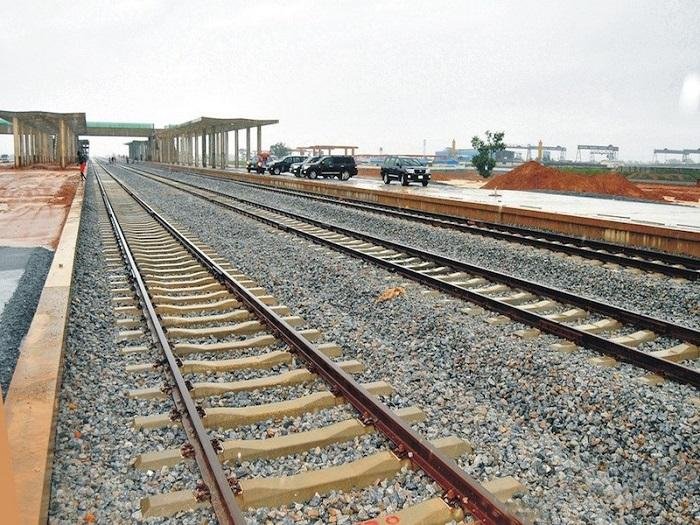
The Federal Government has expressed satisfaction with the pace of work on the Kaduna–Kano rail line project, declaring that the corridor and its train stations have reached an advanced stage of completion.
The Permanent Secretary in the Federal Ministry of Transportation, Funso Adebiyi, disclosed this on Friday during a joint inspection tour with officials of the Debt Management Office (DMO) and other senior government functionaries on a train ride from Jaji in Kaduna State to the Kano Terminal Station.
According to a statement issued in Abuja by the ministry’s Assistant Director of Press and Public Relations, Osima Seddon, Adebiyi described the train journey as seamless and commendable, noting that the Kano terminal station is substantially ready—with only the installation of its name signage outstanding, expected to be completed within two weeks.
Adebiyi confirmed that key safety and quality upgrades requested during his previous inspection had been fully implemented by the contractors. These include replacing toughened glass with safer laminated glass in passenger-accessible areas, installing station lighting bulbs with a minimum three-year lifespan, providing man-lifts for maintenance, and arranging specialised training for Nigerian Railway Corporation (NRC) engineers.
He stressed that only NRC engineers who pass the required assessments following the training will be retained to operate the new facilities.
On the commencement of operations, the permanent secretary revealed that the ministry is proposing a three-month test-run along the Jaji–Kano stretch—potentially as a free passenger service, subject to the approval of President Bola Tinubu—to evaluate structural integrity and operational efficiency ahead of full commercial rollout.
Highlighting the smoothness of the ride, Adebiyi noted that passengers comfortably enjoyed tea, soft drinks, and meals onboard without experiencing noticeable vibrations. He also confirmed that accessibility upgrades for persons with disabilities, including four lifts and an additional rear staircase with imported railings, are being integrated into the Kano terminal, whose waiting hall he said could rank among the best in Africa.
Providing updates on the remaining link between Jaji and Kaduna, Adebiyi explained that security considerations around Jaji required a horizontal curve alignment featuring an in-situ bridge now nearing completion. Track laying will commence once the bridge structure is finalised, while the Kaduna train station is undergoing expansion to handle increased passenger volume.
He added that work is also progressing on the Kano–Kazaure–Daura–Katsina corridor—despite minor land acquisition hurdles between Kano station and Dawano—as part of an integrated national rail network linking Apapa, Ibadan, Abuja, Kaduna, Kano, Katsina, and extending to Maradi in Niger Republic.
Also speaking during the tour, DMO Director-General, Ms Patience Oniha, commended the ministry and contractors for the quality of work delivered, noting that the visit allowed the agency to assess the value of government-funded infrastructure investments firsthand.
In their remarks, CCECC Project Coordinator, Mr Mark Xu, and Project Manager at Team Nigeria Consultants, Precious Ebare, reaffirmed their commitment to maintaining international design standards for a timely handover.