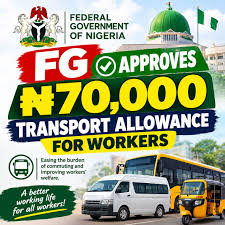
The Federal Government will pay workers a monthly transport allowance of N70,000 for six months, beginning in November 2026, to cushion the effects of economic challenges.
The decision was contained in a resolution reached at the end of a conciliation meeting between the Federal Government and the Nigeria Labour Congress (NLC) on Tuesday in Abuja.
The meeting was convened by the Federal Ministry of Labour and Employment to address workers’ welfare concerns following the NLC’s demands for improved conditions of service and economic relief.
The resolution was signed on behalf of the Federal Government by the Minister of Labour and Employment, Dr Muhammad Dingyadi; Director-General of Budget, Mr Tanimu Yakubu; and Permanent Secretary of the Service Welfare Office in the Office of the Head of the Civil Service of the Federation, Dr Garba Abdul.
The NLC President, Mr Joe Ajaero, and the National Secretary of the Joint National Public Service Negotiation Council (JNPSNC), Mr Olowoye Gbenga, signed on behalf of the labour unions.
The resolution stated that the transport allowance would commence in November 2026 and cover workers across all levels for six months.
“That transport intervention of N70,000 commencing from November, 2026, would be paid across all levels for a period of six months,” it stated.
The meeting also agreed that payment of peculiar allowance arrears would begin in November 2026, with outstanding amounts to be paid in three equal monthly instalments.
The resolution stated that the peculiar allowance had been approved by the Federal Government, effective from May 1, 2026.
It added that the arrears would be paid in three equal instalments beginning in November 2026.
The meeting further agreed that 19 months of outstanding allowances owed to health workers would be paid within three months, beginning in December 2026.
On the national minimum wage, the parties agreed that the Minimum Wage Negotiation Committee would be constituted and commence meetings immediately.
However, the resolution noted that both parties disagreed on the effective date for implementing the minimum wage.
Regarding tax relief for workers, the meeting agreed that the matter would be referred to the National Executive Council, as taxation was a statutory issue.
The resolution also stated that the Federal Ministry of Agriculture and Food Security had submitted the list of beneficiaries and the cost implications for agricultural workers’ hazard allowances to the National Salaries, Incomes and Wages Commission (NSIWC) for verification.
The verification was expected to be completed within two weeks, after which the commission would issue an implementation template.
On the Consolidated Health Salary Structure (CONHESS), the NSIWC was expected to complete an updated cost assessment within three weeks to enable the Presidential Committee on Salaries to decide on the adjustment.
The resolution urged state and local governments to participate in the intervention process and called on unions to pursue the implementation of the agreed measures.
It added that both parties would reconvene after one month to assess the level of implementation of the resolutions.