Nigeria and the United States have signed a Critical Minerals Framework aimed at deepening investment in Nigeria’s mining sector and strengthening cooperation across the mineral value chain.
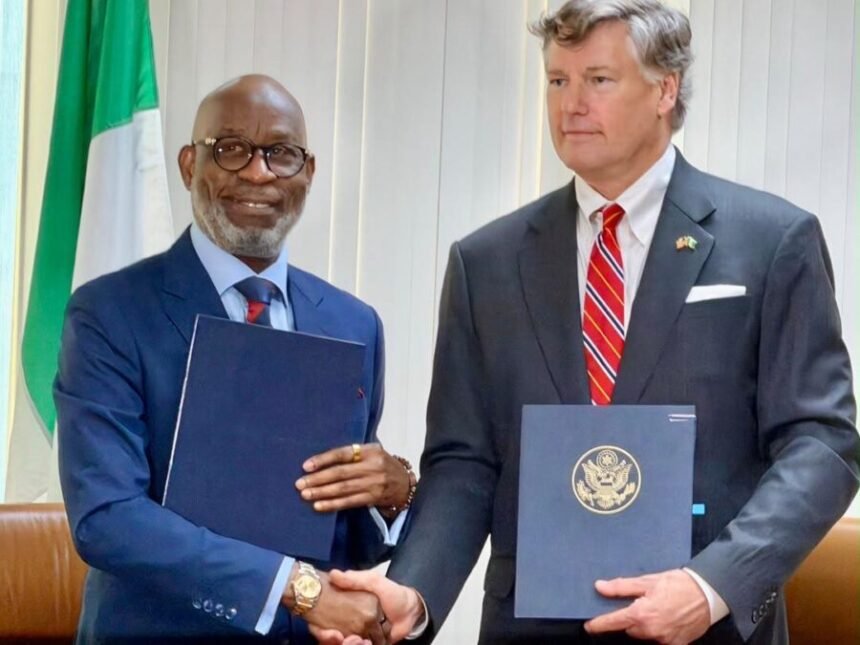
The agreement was signed on Sept. 23 at Nigeria’s Mission House in New York on the sidelines of the 81st Session of the United Nations General Assembly by Nigeria’s Minister of Solid Minerals Development, Dr Dele Alake, and U.S. Deputy Secretary of State Christopher Landau.
The U.S. Department of State said the framework would expand opportunities for American companies to access Nigeria’s critical mineral resources while strengthening U.S. supply chains.
The framework covers cooperation in geological data, mineral exploration, development and processing, infrastructure and technical capacity building.
It is designed to leverage government-to-government relations to encourage business-to-business transactions and attract American investment across Nigeria’s mineral value chain.
Nigeria estimates that its mineral resources are worth about $700 billion and is seeking greater investment to diversify its economy beyond petroleum.
The U.S. said the framework would advance responsible development of Nigeria’s resources to support economic growth in both countries.
At the signing, Alake described the framework as an agreement capable of shaping the future of economic relations between both countries.
“Some agreements manage the present, and some agreements shape the future. The framework we sign today belongs to the second kind,” he said.
Alake stressed that Nigeria’s priority was not simply to extract and export its mineral wealth in raw form.
“Our goal is to turn potential into lasting value at home through stronger local processing, new skills, quality jobs and new opportunities for Nigerian businesses.”
According to him, cooperation under the framework would span exploration, mineral development and processing, infrastructure and technical capacity.
Alake said the partnership would support the administration’s economic diversification agenda and promote industrialisation through increased domestic value addition.
Nigeria possesses deposits of lithium and other minerals increasingly required for batteries, renewable-energy systems, advanced manufacturing and emerging technologies.
Alake said signing the framework represented only the beginning, stressing that implementation would determine the actual benefits for both countries.
“Now comes the harder and more important work: moving from agreement to implementation. A signature is a promise, results are the proof.”
Landau described Nigeria as a strategic U.S. partner and an important regional power because of its population and economic significance.
He said the framework would create opportunities for greater prosperity in both countries and reaffirmed Washington’s commitment to Nigeria’s economic growth.
The U.S. announcement also places the Nigeria agreement within Washington’s broader efforts to strengthen critical-mineral supply chains and expand American private-sector investment in Africa.
The U.S. and African Union have also advanced infrastructure projects through their Strategic Infrastructure and Investment Working Group.
Washington said the initiative was creating new opportunities for U.S. private-sector investment across Africa, including in transport, trade, energy, digital development and critical-mineral supply chains.