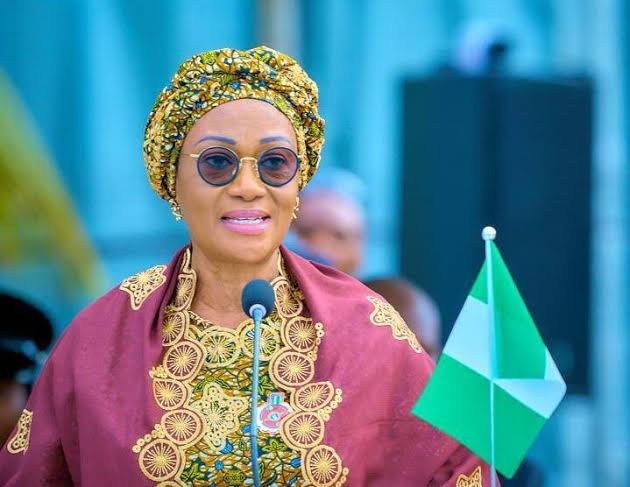
Akwete, the quiet community in Ukwa-East Local Government Area of Abia, took the centre stage in the media recently following a visit by the First Lady, Sen. Oluremi Tinubu.
Akwete weaving, named after its place of birth, the Akwete community, was the main talking point.
During the visit, meant to promote the Akwete heritage, Mrs Tinubu made several remarks to achieve that purpose but the most quoted soundbite was: “I said, if God brings my husband in a second time, I will be wearing a ‘buba’ wrapper from Akwete.”
Curiously, the second part of that quote, which was meant to celebrate Akwete, was left out by many bloggers and, perhaps, clout chasers. She said: “I will wear it because it is made from soft, breathable cotton.”
During the visit, the First Lady announced a donation of N2 billion to support the preservation and promotion of the renowned Akwete weaving heritage.
In a politically charged atmosphere, Mrs Tinubu’s visit was seen a campaign stunt for her husband, President Bola Tinubu.
However, observers say a closer look at it rather shows a move capable of placing the Akwete weaving culture in its right place in the local and international fabrics industry.
This thought was hinted at by Tinubu when she said: “I will give a little advice to the governors (of the South-East) about these women while they keep their craft alive.”
The First Lady highlighted the spiritual connection in the Akwete fabric culture and art.
“It is a spiritual thing for them, and one of the good things I saw was young people in their families doing exactly one thing.
“So, it is a craft transferred from generation to generation. When we bring in people who do that, it becomes a sacred craft done with love, patience, and endurance.
“It is something spiritual that should not be desecrated.
“There is nowhere I stand in the world, even the white person is always in awe of my personality. You saw when we went to the palace (Buckingham Palace), we’ve been to places and I wear African wear,” she said.
As observed by Chief Sam Onuigbo, a frontline politician and culture advocate, rather than negatively framing Mrs Tinbubu’s visit and remarks, it should serve as a momentum to sell Akwete even to international consumers and fashion enthusiast.
“Enveloped in that great remark is the potential of Akwete to augment Nigeria’s cultural diplomacy following the Asoko and danciki ensemble.
“Through her visit and cross fertilisation of ideas, the First Lady inadvertently challenged Igbo women.
“This is particularly the Akwete cloth weavers to emulate their counterparts in Ogun and other parts of the South West, who have raise Asoke/Adire attire into not only as a symbol of cultural identity, but also global acclaim.
“As a widely travelled and elegant personality, the First lady was also doing a bit of soft marketing when she described Akwete as very soft and breathable cotton,” said Onuigbo, a former member of House of Representatives and sponsor of Nigeria’s Climate Change Act.
Another critical area that the president wife’s visit underscored is proper funding and empowerment of the Akwete weaving women whose trade has been affected by the recent national economic challenges.
For such women, weaving is their only means of livelihood and sustaining their families; hence the N2 billion promised by the First Lady should serve as a major boost to the trade.
Mrs Helen Ebere, the President of the Akwete Cooperative Society Plc, which has no fewer than 200 women in its fold, said patronage had declined lately due to insecurity and a drop in Nigerians’ purchasing power.
“It will not be easy to sustain the trade as things stand now but if there is assistance made available to help us then the business will be sustained.
“Our clothes, unfortunately, are not much in demand now. We have been having few orders since 2010 because of the rise in the cost of production materials,”Ebere said.
Prof. Chinedu Nwajiuba, the former Vice Chancellor of Ekwueme Federal University, Ndufu Alike, Ebonyi, wants Igbo intellectuals, elite, entrepreneurs and celebrities to lend much support to Akwete as Mrs Tinubu has demonstrated.
It is worth noting that Nwajiuba established the Centre for indigenous Clothing at the university.
Nwajiuba added that the centre focused on Akwete weaving and encouraging the cultural pride of Akwete people as well as teaching an Akwete weaving course.
“The university also encourages students to wear Akwete cloth on ‘Traditional Dress Mondays’ and clothes produced to important visitors as gifts,” he said.
Nwajiuba also wants the media to do more in projecting Akwete fabrics, adding that prominent persons and celebrities should take pride in wearing to international events as seen in the case of Asoke and Kente of Ghana.
He also advocated that Akwete clothes be advertised at strategic places such as hotels, airports, government houses, Aso Rock Presidential Villa, among others.
He said social media influencers should also join in the crusade to market the local fabric by bringing it to the attention of their international audiences.
Stakeholders say as a follow-up to the First Lady’s visit, conscious efforts should be made to upgrade infrastructure, inject targeted funding, apply technology to scale up output, and boost local and international patronage of Akwete fabrics.