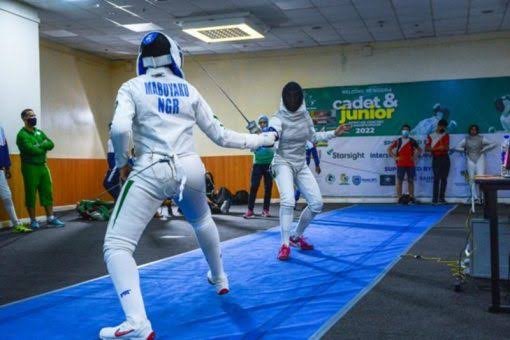
President of British Fencing, Pat Aiyenuro, has predicted a more even distribution of medals at the 2026 Commonwealth Fencing Federation Championships in Lagos, saying the era of a single nation dominating the competition is coming to an end.
The News Agency of Nigeria (NAN) reports that the championships, scheduled to hold between Aug. 9 and Aug. 14, will mark a historic milestone as Nigeria becomes the first African country to host the senior event.
The competition will take place at Rugby School, Atlantic City, Lagos, where fencers, officials and executives of the Commonwealth Fencing Federation are expected to converge.
At the last Senior Commonwealth Fencing Federation Championships held in London in 2022, England finished top of the medals table with 57 medals comprising 22 gold, 10 silver and 25 bronze medals.
While acknowledging England’s long-standing dominance in the sport, Aiyenuro, who also serves on the Executive Committee of the International Fencing Federation, said the increasing competitiveness of other Commonwealth nations would make this year’s competition more open.
“England has consistently been one of the strongest nations in Commonwealth fencing because of the depth of its athlete pathway and the strength of its domestic competition.
“I expect England to be highly competitive once again,” she said.
“However, other Commonwealth countries are now just as competitive. I think this year there will be more spread of medals across all nations.
“Countries such as India, Jamaica, Wales, Australia, South Africa, Canada, Singapore, Mauritius, Kenya, and host nation Nigeria have all invested in developing their programmes.
“I anticipate very competitive contests across all three weapons, and no team can take success for granted,” she said.
The British Fencing president also commended the Nigeria Fencing Federation for its progress in organising international competitions over the past five years.
She noted that hosting an event of such magnitude would leave lasting benefits for both the sport and the country.
“Hosting an event of this magnitude provides lasting benefits. For fencing, it increases visibility, strengthens coaching and officiating standards, and creates opportunities to develop volunteers and event organisers.
“Beyond fencing, it demonstrates Nigeria’s ability to host major international sporting events, boosting confidence among federations and investors.
“It also delivers economic benefits through tourism and showcases Nigeria to the wider Commonwealth sporting family.
“Perhaps most importantly, it inspires young athletes by giving them the chance to witness elite competition on home soil,” Aiyenuro said.