By Peter Olorunnisomo
The exhibition title, Crumbs, would ordinarily not suggest the creative plurality of the assembly of artists at the Indra Gallery on Old Street, London. It would likely suggest a children’s event but it had more ironic reality to it than could have been guessed. What with cartoon-like art spilling everywhere over the brochure, the strongest clue of the creative armada that was coming to the public, with the twenty-six names of the collective whose works were on display.
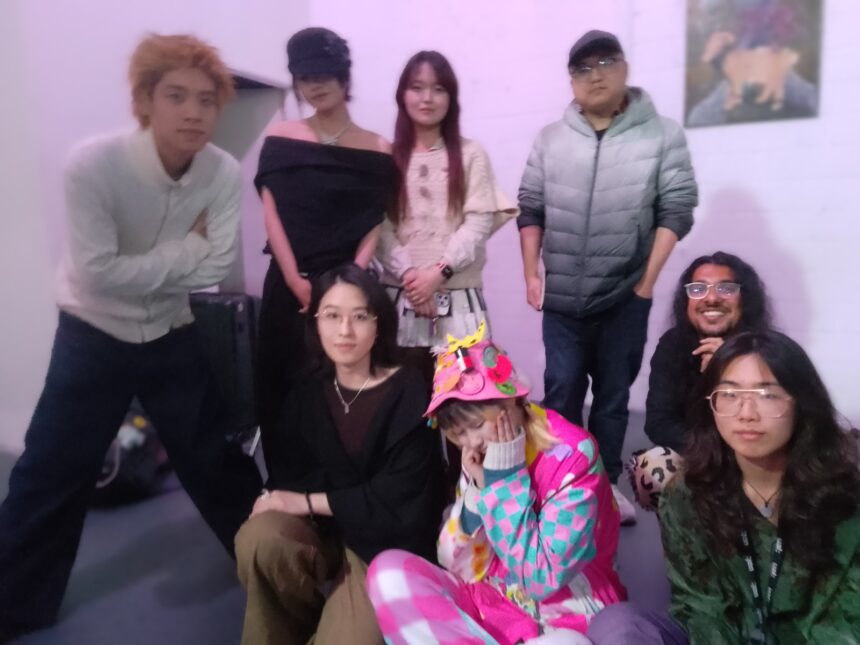
It featured a cream of university students, all from different universities and a few independent artists. Of the lot, there was an Italian, and two English artists while the others were all Asian, and, dominantly, Chinese. Yet it was a not a convergence for an art assault but rather an uprising of potentially new artists from a generation expressing bohemian notions of art and unified by calls to concerns in the societies across borders.
With the project curated by Xinzhu Huang, also called Xixi (pronounced Sisi), herself a postgraduate student with an obsession with and for ‘Wellbeing’, and whose research is also on the same subject, the community of artists that exhibited possibly reflected experiences from which sprang their concerns, egging on passionately, to produce works that voiced their concerns guided by their beliefs, cultures, and time-tested sayings.
The artists, upon interview, admitted experiences in their younger years, which ordinarily can be understated by aggregating them all as exuberances, but rather have impacted differently on their psyche. Environmental influences and a new culture of societal permissiveness, indifference, fast-paced development without safe-guards for humanity, and negativities transformed to norms, all seemed to alert these sensitive, creative minds that a drift away from the normal is being normalised; and issues of individual and societal well-being are very much sacrificed for perceived social righteousness.
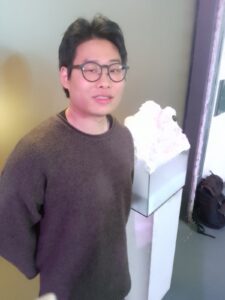
Alessandro Paiano (with his digital box)
Individual experiences, according to a cross-section of the artists, have resulted in their perception of well-being as living with pain, social judgements, abuse, sorrow, varied situations of loss from identity through social structure, roles, fulfilment, to happiness among others. These they reject. Sisi, thoughtfully reflects from an agglomeration of these emotions, the call to soak her emotional, financial, cultural, and intellectual energies into the imperative re-definition of what wellbeing should mean. She clued in that this search, for a definition, is a primary motivation to allow these artists express that part of their emotional voyages through their art. After all Georges Braque said, “Art is a wound turned into light”.
This collective appears to strongly align with the notion that they are able to reject and protest, and let their art mediums speak for them through a process that allows healing by reducing anxiety, processing trauma, and improving mental health. It liberates them to foster a sense of accomplishment, and ultimately improving quality of life. And very well cope with society’s ‘norms’ Would that be a sense of wellbeing?
Yichen Zhao had to shake off the shackles of conveniently living with pain to cross bridge from a skilled sculptor to using ceramics and allowing the process of creating art with ceramics to influence her healing. Alesandro Paiano found expression to relish memories of his Confession and protest with his unusual medium using digital animation to recount his first kiss from the small box called a camera. Xitong Li’s plastic, metal, and latex to create a dragon’s hands with claws and a piece that showed the skeletal essence of animals so delicately and intricately measured, detailed with the muscle and the sinews of flesh entwined between the bones, unifying the entire body mass that can readily and easily be for most animals that would probably exist from Chinese history and anywhere on earth. For her, these are independent units of existence without any form of order creating the oscillation between doubt and recognition. It was as if she was pointing us back to a natural order of beauty that has really been missing in humanity for quite a while.
If there was the expectation to look at the walls as a usual sight of exhibition, one would be readily disappointed. Yes, the white walls were guilty of inadequate assembly but the exhibition was perhaps pointing to new direction of this generation of art media which seemed to expand the scope of ‘everything usable is creatively conquered for expression’, perhaps also indicative of what might portend as generational concerns of the world’s drift into what is being thought of as technological advancement for man’s wellbeing. Indeed, digital notions, as tools, helped shaped parts of the reality of the exhibition creatively. But it is very possible that these artists are pointing to different concerns and use to which these advancements could also be deployed for humanity’s wellbeing.
The exhibition ran from 16th April – 21st April, 2026.
Peter Olorunnisomo, FRSA, MCIPR writes from London.
Images: Xinzhu Huang (sole xter)