
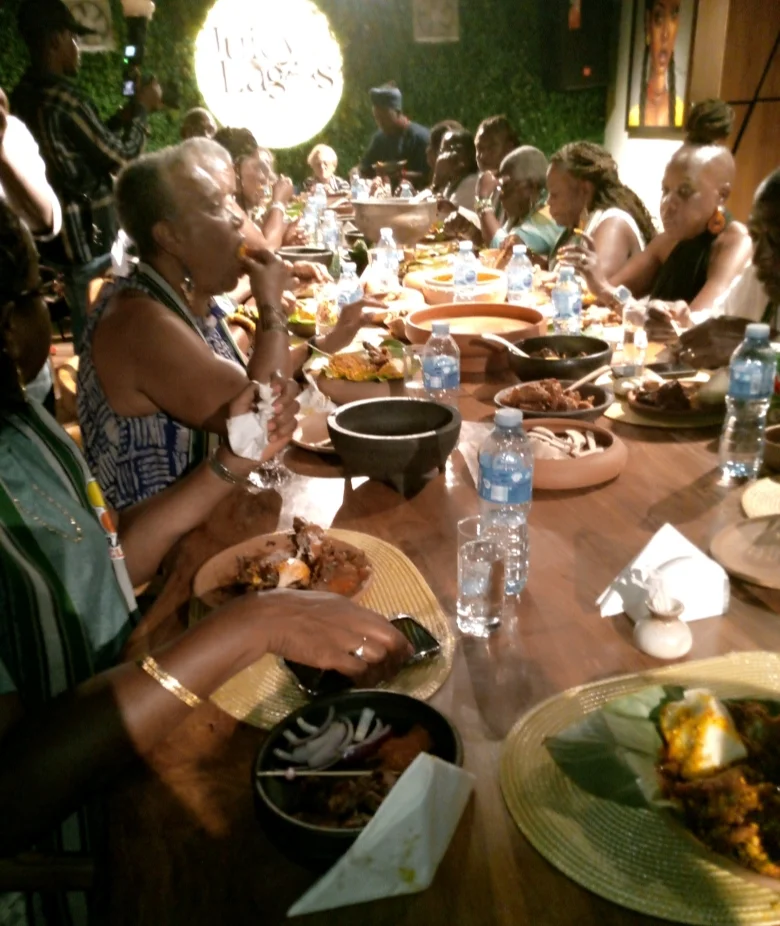
A group of U.S. tourists exploring Lagos through a cultural tour designed to connect diaspora visitors with local traditions, heritage sites and cuisine, say their experiences will reshape Nigeria’s global perception.
The News Agency of Nigeria (NAN) reports that the visitors, part of a diaspora tour, led by the Goge Africa Travel Club, made this known when they were hosted to a dinner on Monday in Lagos.
The event was organised by Goge Africa, with the support of the Special Adviser to the Lagos State Governor on Tourism, Arts and Culture, Idris Aregbe.
The visitors who hail from different nationalities residing in the U.S., had spent two days in Lagos experiencing different aspects of the city’s culture, including markets, museums, heritage sites and food tastings.
Speaking on the initiative, the Chief Executive Officer of Goge Africa, Isaac Moses, said the trips were designed to give diaspora visitors a first-hand experience of Nigerian culture beyond what they used to hear abroad.
Moses noted that similar tours had been organised previously, including one in November that brought nine visitors from Los Angeles to Lagos.
“Last November, we had nine coming from L.A., and we actually took them to Oba Oniru (traditional leader of Oniru) so they could give them a local name.
“They gave them names, they told them the meaning of their names and they were all very excited,” he said.
According to him, many visitors arrive with mixed expectations about Nigeria because of some negative narratives they may have heard overseas.
“Normally they come with their fingers crossed. They hear things. They don’t know what exactly to expect.
“So they come in with a little skepticism but we allow them to experience the good, the bad, the ugly.
“Whichever one comes but we believe they are going to have more good,” he said.
He acknowledged that some visitors pointed out areas where Nigeria’s tourism infrastructure could improve, particularly transportation for tourists.
“The only experience they would have had that I would say wasn’t too palatable was that they considered some of our food too hot.
“Then the buses, we don’t have tour buses. Some of them are tall and their knees felt cramped,” he said.
He urged investors and transport companies to provide buses designed for tourism, similar to those used in other African destinations.
“Those already into bus rentals should up their game and get buses like they have in Kenya, Ghana, South Africa, Egypt and Morocco,” he said.
Also, Aregbe said cultural tourism was central to promoting the state’s heritage and attracting international visitors.
Aregbe, who was represented by the Director of the Lagos State Council for Arts and Culture, Idowu Johnson, said that the council was tasked with the preservation and promotion of indigenous traditions.
“What we do there is that we preserve, we promote and we document Lagos indigenous culture,” he said.
According to him, showcasing culture helps counter the belief that Lagos has no indigenous heritage.
“People think that Lagos is no man’s land, that Lagos doesn’t have a culture but Lagos has a culture,” he said.
He cited traditions across different parts of the state, from Badagry to the mainland, noting that festivals and heritage practices remain part of community life.
“When people come around, let them come and experience Lagos, let them come and experience culture,” he said.
He added that such visits also stimulated economic activity.
“The person that comes from abroad is coming with his dollar to spend. He eats our food, he stays in our hotel, he enters our taxi.
“At the end of the day, it increases our economic turnover,” he said.
For some of the visitors, the trip also offered a personal journey of cultural discovery.
Karen Morris-Clarke, leader of the tour group and Founder of Bella World of Travel, said she brought the 19-member group to Nigeria after first visiting Ghana on a motherland tour.
Morris-Clarke, who was born in Jamaica and has lived in the U.S. for decades, said she had long wanted to visit Nigeria after discovering her Nigerian ancestry through a DNA test.
“My daughter did a DNA test and we had Nigeria on the list.
“So for me, I realised that I have Nigerian ancestry in me, so I wanted to come home,” she said.
She said the group encountered both positive experiences and challenges during the trip, particularly with transportation and group logistics.
“The first issue we had was the condition of the bus.
“We were honestly very cramped. We’re not very used to that as tourists,” she said.
In spite of these concerns, she praised the hospitality of Nigerians and said the group felt safe throughout their stay.
Morris-Clarke also acknowledged that many people abroad still had negative perceptions about Nigeria.
“There’s this negativity still associated with Nigeria, a stigma that I think needs to be worked on but I’m happy I came. I experienced it for myself,” she said.
Food was another key element of the cultural exchange during the visit.
Chef Gbolabo Adebakin, popularly known as Chef Gibbs and convener of the Nigeria Food Summit, said culinary experiences play a major role in promoting Nigerian culture to international visitors.
“Part of the work that we do is hosting guests from across the world and educating them about Nigerian food,” he said.
He explained that many people abroad misunderstood Nigerian cuisine, often describing it as heavy or overly fatty.
“With the work that we’re doing now, we’re rebranding and letting people know that our food is very communal, very nutritious and very rich.
“Food is the oldest form of tourism,” he said.
The tourists were welcomed and entertained by the Lagos Dance Troupe, and treated to various Nigerian and Lagos cuisines like soups, swallows, rice and palm wine, among others.
Guests also participated in cooking demonstrations.