
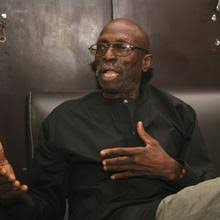
Lawyer and human rights defender, Femi Falana (SAN), has recalled the role Professor Emeritus of English at Cornell University, USA, Biodun Jeyifo, played in his academic career at the University of Ife, now Obafemi Awolowo University, Ile-Ife.
Falana made this known on Monday when he and other dignitaries celebrated Jeyifo as he turned 80 years old.
Jeyifo, who is also a professor of Comparative Literature and African and American Studies, Harvard University in the US, was celebrated at the Muson Centre, Lagos, by family and friends.
The News Agency of Nigeria (NAN) reports that the event, a symposium, was organised by the Wole Soyinka Centre For Investigative Journalism (WSCIJ).
The symposium in honour of the celebrant, had the theme ‘Pedagogy, Curriculum and Decolonisation: Then and Now.
Falana while speaking at the ceremony, said that Jeyifo was one of the lecturers at the University of Ife, now Obafemi Awolowo University (OAU), Ife, who made him graduate from the university.
“I can publicly claim that he was one of those lecturers who incited me in Ife, to do what I am doing today.
“Way back in our days in Ife, I can say, without any fear of contradiction, that the likes of Jeyifo, Prof. Wole Soyinka, and some others, made it possible for me to graduate.
“I was very stubborn and the authorities used to threaten us, but the big ears of this hall would not allow it.
“But as the Academic Staff Union of Universities (ASUU) president then, he ensured that all the radical lecturers, all the Marxist lecturers that were dismissed were reinstated,” he said.
Falana thanked the celebrant for his tutelage as a lecturer, adding that there were now some couple of laws he would like to share with him.
“All Nigerian children, every child in Nigeria, shall be given free and compulsory education.
“We also have now compulsory health insurance. for all Nigerians. It’s already a law now.
“All physically challenged people in Nigeria, there is also a law, disability law, that provides that all physically challenged people shall have free and compulsory education up to senior secondary level.
“The last one is the National Social Investment Act, which now stipulates that there shall be cash transfer to the vulnerable people in the society,” he said.
The legal practitioner added that there would be one nutritious meal a day for primary school pupils in Nigeria.
“So we want to thank you once again, sir, for what you did, for teaching us, even outside your classroom,”he said.
Also. Dr Yemi Ogunbiyi, Chairman, Tanus Books, said that he had known Jeyifo since 1961 during his high school days.
Ogunbiyi, who regarded the celebrant as a brother, appreciated him and also prayed for him while wishing him well in his endeavors.
Prof. Priyamvada Gopal, a professor of Post-Colonial Studies at the University of Cambridge, gave the keynote address at the occasion.
She said that decolonisation was not automatic, therefore was never the result of a mere fiat arising out of the conscience of the colonizer.
“It is always the result of a struggle, the result of strenuous efforts. Even the most peaceful form of decolonisaton is always the result of a rupture.
“Colonialism is nothing if not the dynamic of appropriation, dispossession, extraction, ecocide, and wealth concentration, that is capitalism.
“This process is less racialised than it used to be, certainly, though still far from transcending race.
“Rather than turn us away from seeing anti-capitalism as fundamental decolonisation, I think we are invited to think about which colonial strategies and philosophies persist, not only as neo-colonialism, but as renewed colonial projects within and by nation-states,”she said.
Gopal said that this was a form of recolonisation familiar both in Nigeria and India, where deeply destructive and extractive corporate projects harm and dispossess local communities and ecosystems.
“In 1959, at the second Congress of Black Writers and Artists held, this time in Rome, Césaire would address the neologism of decolonisation.
“I won’t read this quotation, but this is what he had to say.
“While stressing that even the worst decolonisation is better than the best colonisation, Césaire makes an important observation often forgotten today.
“The difference between decolonisation and colonisation is not one of degree, but of kind. Decolonisation has to be qualitatively different from colonialism, not just a change,”the don said.
Gopal added that it simply could not mean embracing a whole dynamic of colonialism itself.
“Ultimately, however, the work of decolonisation is the work of the imagination, posing the fundamental question humanity has to ask of itself on behalf of future generations.
“As Césaire puts it, what sort of world are you preparing for us? Perhaps the answer to this sits in the realm of literature and culture, but we must begin to answer it,” she said.
Earlier, the Executive Director, WSCIJ, Ms. Motunrayo Alaka, in her welcome address, said that the theme was fitting.
“It invites us to look backward with honesty, forward with responsibility, and inward with courage.
“These are questions Prof. Jeyifo has spent a lifetime asking and insisting that the rest of us ask too.
“Today, we celebrate Jeyifo at 80. We recognise his accomplishments as a scholar whose work has shaped how we read African literature, interrogate power, and understand culture,”she said.
She added that Jeyifo’s scholarship on the works of the grand patron, Prof. Wole Soyinka, remained foundational.
“Perhaps, even more enduring is his insistence that knowledge must always be questioned: who produces it, who benefits from it, and who is left out.
“This gathering is both celebration and reflection. Prof. Jeyifo’s work has never allowed us the comfort of easy answers.
“Instead, it has urged us to pay attention, to power, language, silence, and to the structures that define society.
“These questions resonate deeply with us at the WSCIJ, where we see education, media, democracy and journalism as public responsibilities,”she said.
Jeyifo, during his remarks, appreciated everyone who had come to celebrate with him as he discussed about the poverty statistic in Nigeria.
“The poverty statistic in Nigeria in 1975 was about 47 per cent of the population, now it’s about 62 per cent of multi-dimensional poverty. So, look, it’s the reverse.
“It’s the reverse now of the other statistics. It was 47 per cent in 1975, and it is now about 62 per cent of the population.
“Overwhelmingly under 20 per cent of them are in multi-dimensional poverty. The reason poverty matters to me especially, when I returned in 1975, I became the editor of a journal of a movement called the Anti-Poverty Movement of Nigeria,”he said.
The celebrant said he was deeply touched by the love he was given by his students both home and abroad.
Also in attendance at the symposium were Mr Kunle Ajibade, Co-Founder The News and PM News, Mr Dapo Olorunyomi, Publisher, Premium Times, Mr Sam Omatseye, Chairperson, Editorial Board, The Nation and many more.