
The National Agency for the Prohibition of Trafficking in Persons (NAPTIP) says human trafficking and violence against persons remain pervasive issues that require concerted efforts from all stakeholders.
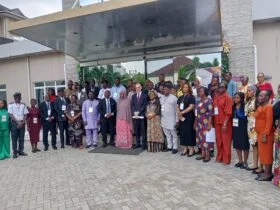
The agency’s Director-General, Binta Adamu Bello said this at the opening of a four-day workshop on Tuesday in Lagos.
The workshop is being organised by NAPTIP in partnership with the international Centre for Migration Policy Development (ICMPD).
It is supported by the Ministry of Asylum and Migration of the Kingdom of the Netherlands under the Building and environment free of human Trafficking and Violence Against Persons in Nigeria (TIPVAP NG).
The News Agency of Nigeria (NAN) reports that the four-day workshop aims to strengthen investigators, prosecutors and related enforcement agencies on Trafficking in Persons (TIP) and Violence Against Persons (VAP).
Declaring the workshop open, Bello said her agency remained steadfast in its mission to prevent, protect, investigate, and prosecute cases of human trafficking and violence against persons in Nigeria.
“The complex nature of TIP and VAP demands a multi-disciplinary response that brings together diverse expertise and perspectives.
“This workshop has been designed to foster collaboration across different agencies and institutions because the agency recognises that working at cross purposes cannot defeat the criminal networks involved in these crimes.
“In combating these crimes, we can only succeed through the efforts of financial investigators who track the proceeds of exploitation.
“The prosecutors who execute court cases; and social workers who support victims, each perspective contributing to a comprehensive response.
“This workshop is also intended to enhance the capacity of our investigators, prosecutors, and our sister law enforcement agencies to effectively handle cases of human trafficking and VAP.
Bello said: We are focused on strengthening our response mechanisms, improving inter-agency collaboration, and ensuring that our efforts are informed by best practices and international standards.”
She said that manifestations of human trafficking varied across regions, but shared common threads of exploitation and abuse, from the sexual exploitation of women and girls transported across West Africa to the forced labour of men in construction and agriculture.
She said the crimes represented a fundamental violation of human rights and human dignity, noting that the drivers of human trafficking were as complex as they were prevalent and evolving.
“Factors such as poverty, political instability, conflict, and systemic inequalities create fertile ground for traffickers to operate,”she added.
Bello added that contextual issues—including single-parent households, broken homes, the prevalence of child sexual abuse, and what some experts described as a “culture of silence”—further compound individuals’ vulnerability to human trafficking and exploitation.
“These challenges are not unique to any single nation or region; they demand a synchronised transnational response that addresses both supply and demand factors” she said.
Speaking, Michel L. H. Deelen, Consul-General (C-G) of the Kingdom of the Netherlands in Nigeria, said the project aimed to strengthen inter-agency collaboration across federal and state levels.
He added that it would equip participants with the technology, skills, and procedures needed to disrupt criminal networks and preserve evidence with integrity for successful prosecution.
Deelen said the workshop therefore focused on enhancing evidence management, strengthening cyber-investigative competencies, and promoting collaboration between investigators and prosecutors.
“Through presentations, case studies, and practical exercises, participants would gain
improve technical knowledge and tools necessary to preserve the integrity of evidence and
support stronger prosecution outcomes.
“Beyond the technical knowledge, this workshop also provides a platform for experience sharing.
“Participants from Lagos State and Ogun bring with them unique perspectives, shaped by the
dynamics of their respective states.
“We encourage you to use this space to exchange lessons,
reflect on challenges, and discuss strategies that can strengthen coordination between NAPTIP
and related law enforcement agencies” he said.
The C-G said successful counter-trafficking work thrived on collaboration and no single agency could respond
effectively to crimes as complex as human trafficking and violence against persons.
He was hopeful that the four days would deepen inter-agency trust, reinforce operational
cooperation, and inspire renewed commitment to the protection of vulnerable groups across Nigeria.