

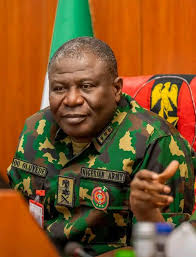
The Chief of Defence Staff (CDS), Gen. Olufemi Oluyede, has reaffirmed commitment to deepening transformation, innovation and joint operations to effectively address evolving security threats across the country.
Oluyede stated this on Tuesday in Abuja at the Fourth Quarter Armed Forces of Nigeria (AFN) Transformation and Innovation Seminar.
He was represented by the Director of Search and Rescue at Defence Headquarters, AVM Idi Sani.
Oluyede described transformation as “an operational necessity, not an option,” stressing that the changing character of warfare and Nigeria’s complex security environment demanded an agile, adaptive and forward-looking military.
He said “the global security landscape is shifting rapidly, with conventional and non-conventional threats intersecting in unprecedented ways, including terrorism, insurgency, cyber warfare and information operations.
“Maintaining operational superiority requires continuous review of military doctrines, modernisation of platforms, expansion of capabilities and the integration of emerging technologies into defence operations.”
The CDS added that innovation remained a critical enabler of operational effectiveness, noting that unmanned systems, Artificial Intelligence (AI), data analytics, space-based technologies and autonomous platforms were increasingly shaping modern battlefields.
He said the AFN would continue to prioritise indigenous research and development, strengthen partnerships with academia and industry, and invest in capacity-building initiatives to equip personnel with skills required for future warfare.
Oluyede emphasised the importance of personnel welfare and continuous development, describing them as essential to sustaining morale, discipline and the will to fight amid rapid technological advancement.
He said the current military leadership philosophy was anchored on enhanced joint operations,
improved force posture and operations, and better welfare supported by sound administration.
“This philosophy guides our collective efforts to strengthen joint operations, deepen inter-service cooperation and build a balanced, resilient and mission-ready force,” he said.
He acknowledged existing challenges, including limited domestic production of defence equipment, funding constraints, capacity gaps in emerging technologies and persistent asymmetric threats.
He, however, expressed optimism that with the right reforms, stronger partnerships and sustained commitment to innovation, the AFN would evolve into a future-ready and technologically-advanced force capable of addressing both present and emerging security challenges.
He commended the Department of Defence Transformation and Innovation for organising the seminar, describing it as “a strategic platform for shaping the future of the Armed Forces.”
Earlier, the acting Chief of Defence Transformation and Innovation, AVM Jeff Ekwuribe, said the armed forces must accelerate transformation and innovation to stay ahead of evolving security threats confronting the nation.
Ekwuribe described the theme of the seminar — “Optimising Nigeria’s Operational Capabilities through Transformation and Innovation: Issues and Prospects,” as timely and compelling, noting that increasing operational complexity across multiple theatres demanded faster adaptation of military methods, systems and doctrines.
He said the military could not afford stagnation at a time when insurgents, terrorists and violent non-state actors were refining their tactics and exploiting technology and social vulnerabilities.
According to him, transformation goes beyond incremental change, stressing that it represents a continuous shift in mindset, posture, capability and institutional culture, while innovation provides the ideas and technologies needed to sustain operational advantage.